
First impressions matter.
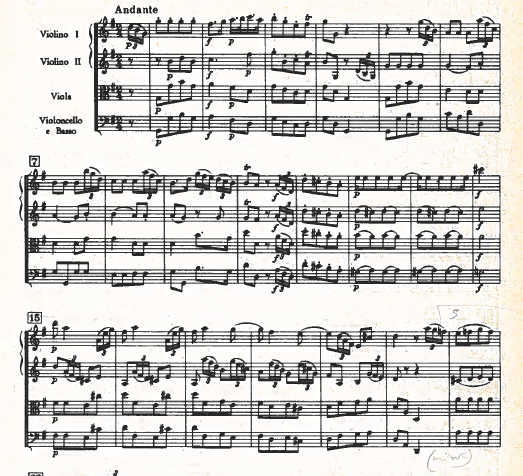
Seriously. Who would ask this of a pair of hornists in 1760?

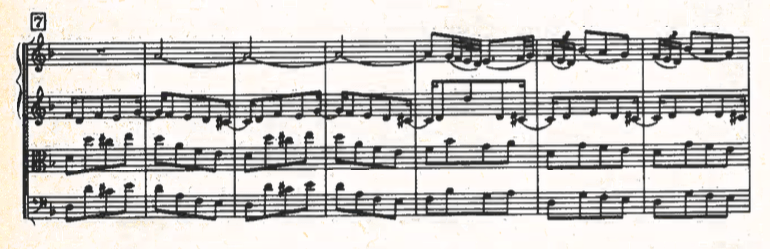
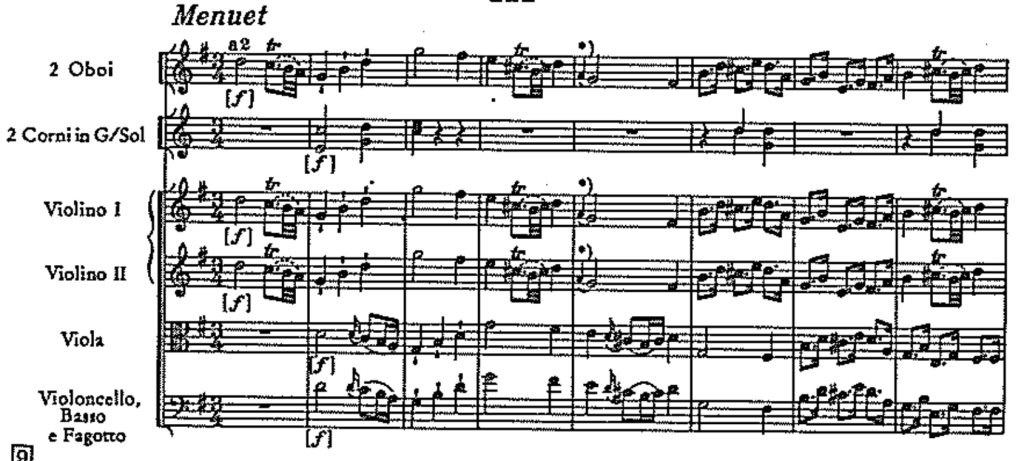
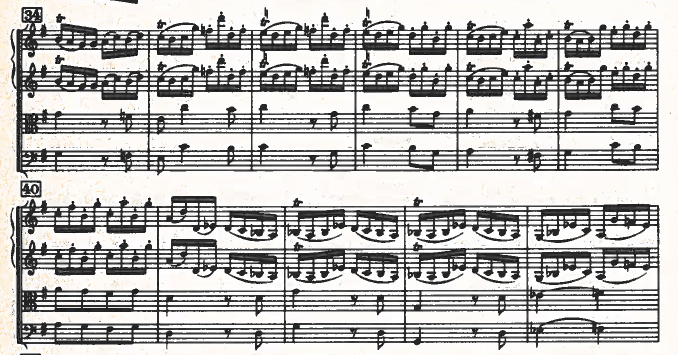
But you should also really consider the (unhinged?) Trio from the third movement. Observe, please, the total absence of any safety net, the radical exposure of the hornists. Were they quaking in their liveries, one wonders? Forget the mannered surety of “hunting horn figures” – these fellas are stalking the jabberwock with laser cannons. Or maybe it’s more like Die schöne Müllerin meets Hair.

This can’t be normal, can it? My initial impression, at least, was that it can’t be. In other words, not the kind of horn writing that seemed tricky in a genteel, doily-dappled past but would gradually become old hat to your average monster hornist. This horn writing sounds like it would remain treacherous. As evidence I note that YouTube offers no live performance, as far as I can tell. And had there been a live performance, just what facial expression might that pair of hornists have worn the bar before their entrance… Grim resolve? Silent appeal to the divine? Rabid-dog excitement? [1]
But then I turned to someone who, you know, actually plays and researches natural horn, fellow San Antonian Dr. Drew Stephen, who explained that the demands Haydn puts on his hornists in the Fifth Symphony are “a little unusual, especially for an early symphony,” but not exceptional. [2] Haydn’s writing in the Fifth simply expects that the hornists would have been comfortable playing in the clarino register, that’s all. Not worlds apart, I suppose, from the bracing effect of clarino trumpet in Brandenburg No. 2. To us lesser mortals it might seem a miracle, but it was once someone’s day job.
My analytical process is always to listen with the score first and to develop my thoughts a bit before turning to other writers, etc. – put it down to anxiety of influence, which is to say that I suspect my own unusual perspective will emerge with greater clarity in the absence of other people’s ideas – and that’s what I did this time. But then, after the eye-popping, spine-tingliness of this horn experience, I turned to my trusty copy of Chronicle and Works, and read this from Landon: “Hardly have the strings begun [in the first movement]…than the solo horns enter with a passage of greatest difficulty [italics added].” And this about the Trio: “This [folk-like] atmosphere is…enhanced by the solo horns (again reaching sounding a’’) and solo oboes.” [3] Yes, Landon half-dresses it up in regalia, but you know what he’s saying, right? Psycho horns. But, pace Landon and my own first impression – sometimes it’s best to trust the experts!
For what it’s worth, the second and fourth movements don’t make such demands. At first, I wondered if Haydn felt he could only get away with asking such things of his hornists if he gave them a smoke break every other movement. That’s what the composer in me might do on a friendly sort of day. And there is a bit of an interrogation atmosphere in this symphony, with alternating bad cop and good cop movements. But here, too, the good Dr. Stephen has assured me that no recovery time would have been needed. “Once you get in that [clarino] groove, it is not particularly tiring.” So maybe Haydn was even being overly cautious by “underwriting” in the second and fourth movements, the opposite of my initial impression. Still, I console myself by observing, in Drew Stephen’s kindly compiled list of clarino horn ranges in early Haydn symphonies, that Papa H. only ever exceeded the (sounding) highest note of the Fifth Symphony once, and then by a half step. So H. I:5 is high, OK? It is! It’s just maybe clarino high instead of psycho high.
Of course I’m being a tad bit silly. All the above might give you the impression that the hornists were bad and that Haydn was punishing them by writing such high parts, but the opposite is more likely. I would guess that Haydn met a couple of hornists – at Count Morzin’s, or perhaps a couple of guest artists? – who were so phenomenally good, so completely rock-solid reliable, that he wrote the symphony with them in mind so they could show off. And, when they performed it? Doubtless the Countess Wilhelmine would have fluttered her fan most fervently at such ferocious horn shredding.
I mentioned that the second and fourth movements don’t have the same kind of “extreme” clarino horn writing, and this means that Haydn’s Fifth is a four-movement symphony. This does not mean, however, that the four movements follow the (yet-to-calcify) classic Haydn design. It’s something quite different, and this adds to the atmosphere of strangeness in a few ways.
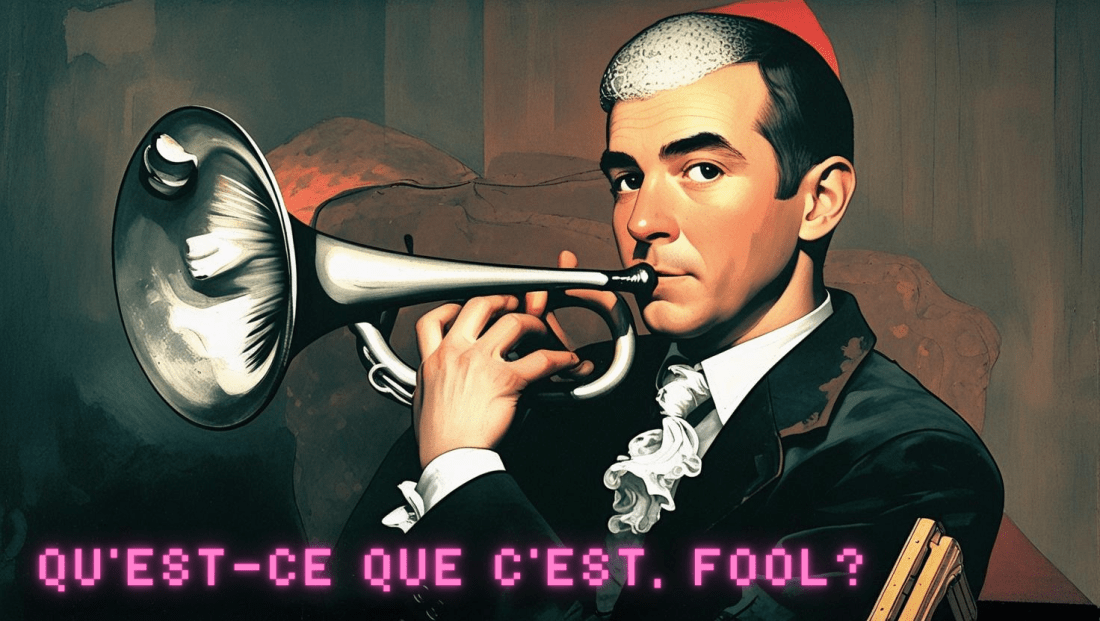
Qu’est-ce que c’est, you ask?
The well-trained musicologist in me did, I admit, recognize in Haydn’s Fifth the outlines of a sonata da chiesa, that by-then old-fashioned four-movement genre with a slow-fast-slow-fast (usually?) design. Oh, you know, the sort of thing Corelli wrote. I wasn’t surprised, therefore, on cracking open my Chronicle and Works to see Landon mention the sonata da chiesa in his comments: “Here is another work in the sonata da chiesa form, opening with an entire Adagio…” [4]
That’s fine up to a point, but the curious thing is that the opening Adagio of H. I:5 is nothing like the kind of slow movement that Corelli would have written. We can easily see the outlines of sonata form in it, albeit with underdeveloped secondary material. Further, instead of giving us a slow third movement à la sonata da chiesa, he gives us a minuet-trio, as we expect in what will become Haydn’s normative symphonic plan. In other words, H. I:5 is a work sui generis and in generic transition, tugging between the Italianate three-movement symphony, the older sonata da chiesa, and the Haydn four-movement design of the future.
Landon drops us another nugget of knowledge in his commentary, and this one gave me an opportunity to learn something new. “Here, in No. 5, we have an interesting example of the divertimento-cassatio technique being applied to such a solemn, slow movement: hardly have the strings begun by themselves (leading us to believe that this is a typical wind-less slow movement) than the solo horns enter…” [5] And you probably remember the rest, or, if you don’t, you can browse the top of this entry. Ye olde “divertimento-cassatio technique,” eh? I had to do some homework for this one – SHOCK! – and strolled for a bit in a budding Grove (Music Online) to get a better handle on “the cassation.”
And?
I’m afraid it’s complicated, as so many generic designations are in the 17th and 18th centuries. What to share? Well, after some wrangling about etymology, the Grove entry writers land on the German Grassaten or Gassaten as the origin of the term cassation, connected to a saying current among mid-18th-century musicians that meant “to perform in the streets” (“gassatim gehen”). [6] So it seems that a cassation has to do with playing outside, which suggests (loud) wind instruments, which in turn explains Landon’s comment about the first movement of the Fifth Symphony, where we’re tricked by the instrumentation and tempo of the opening to expect inside music (strings sawing sweetly) only to be jolted awake by outside music: horns, just about as high as they could go.
Don’t miss this, though! After all is said and done, this opening movement – whatever alchemical amalgam of sonata form and sonata da chiesa and cassation – is an Adagio, and that makes Haydn’s Fifth the first of the numbered symphonies where the slow movement is the first thing we hear and also the first in which a slow movement has wind instruments at all. The wildness of the horn writing, if that’s what it is, is therefore of a piece with the wildness of Haydn’s formal invention.
And that makes Haydn’s Fifth fa-fa-fa-fa, fa-fa-fa-fa far better, I’d say, than the AI-generated mashup of David Byrne+Haydn playing the horn (?) that you will now possibly not be able to unsee.

[1] When do I get paid?
[2] Many thanks to Dr. J. Drew Stephen, Associate Professor of Music History at the University of Texas at San Antonio for an enlightening email exchange about clarino writing, especially in early Haydn! You can hear his introduction to natural horn on his UTSA bio page: https://colfa.utsa.edu/faculty/profiles/stephen-john.html
[3] H. C. Robbins Landon, Haydn: Chronicle and Works, The Early Years, 1732–1765 (Bloomington: Indiana Univ. Press, 1980): 292.
[4] Idem.
[5] Idem.
[6] Hubert Unverricht, rev. Cliff Eisen, “Cassation,” in Grove Music Online, accessed August 16, 2025, https://www.oxfordmusiconline.com/grovemusic.








 Sound Trove