16. Gemeinheit

Into the bald pate of Cassander,

Whose shrieks shatter the air,

Pierrot cranks (hamming it up,

With tender care) – a cranium drill!?

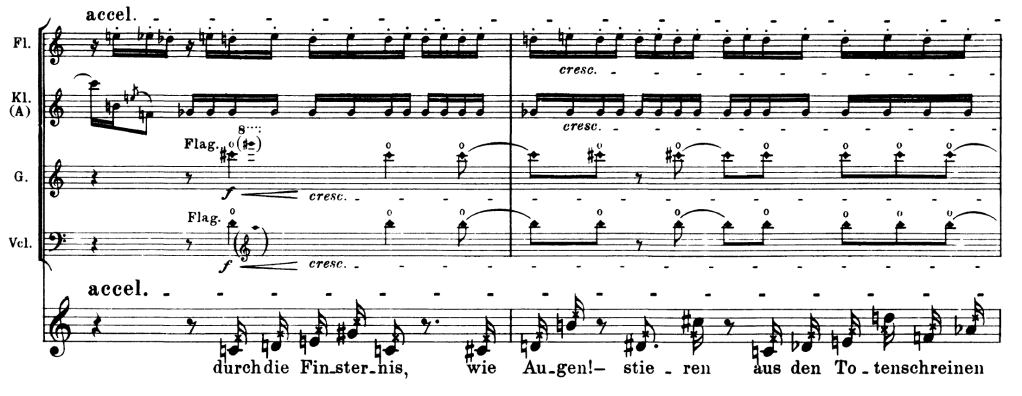
As awful as it is (Gemeinheit: “foul play”; “nasty trick”; “just plain mean!”), it’s all actually quite funny, this one, if you’re in the right sort of mood. Just read the poem – all about Pierrot stuffing fine Turkish tobacco into Cassander’s head while he wails in agony, inserting the pipestem made of Vistula sour cherry wood, and smoking him, “comfortably” – and it might simply seem grotesque, but the music shifts it toward farce, I think. Does it ruin the joke to explain it? And yet look at Schoenberg’s brilliant comic timing after the line about Pierrot’s mock tenderness: a pause, then the punchline – “a cranium drill” (einen Schädelbohrer) – in the vocalist’s most deadpan basement range. The piccolo and clarinet cackle their goofy, razzmatazz laugh track. We are in a performance! Pierrot, fully costumed, has at last come into his own, is doing what he was born to do. He’s cutting up, and the crowd goes wild.
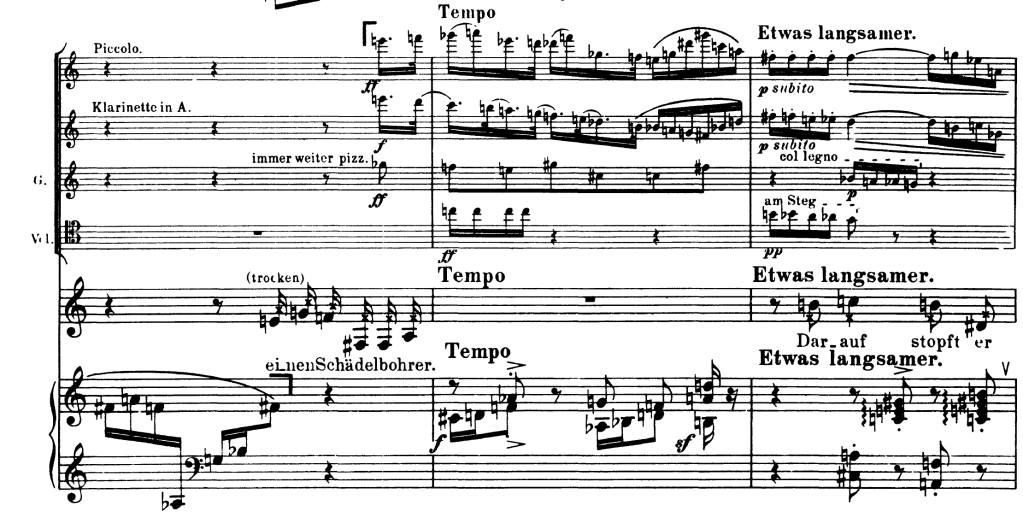
Schoenberg, master of comic timing, “Gemeinheit,” mm. 7-9.

Schoenberg is so economical, his language so packed with purpose, that the piccolo-and-clarinet laugh track isn’t just that. Look at how, at the end of the bar (m. 8), the duo have sextuplets in contrary motion for the turning of the cranium drill, and how immediately in the next bar they’ve traded it for the gruff, four-square repeated sixteenth notes with chromatic motion that opened the movement in the cello. I’m fascinated by the last gesture, I suppose because it’s less clear what it’s doing, but my sense of it is as follows: Pierrot is “rolling up his sleeves and getting it done,” a kind of nonchalance as he matter-of-factly shows the drill to the audience, perhaps, or checks that he has the right drill bit in, etc. Maybe you visualize it differently, but however you do, it’s still three meaning-rich gestures in four beats: one responding to the vocalist’s Schädelbohrer line, one mimicking the drilling motion, and one conveying character and giving us a sense of return in the movement.
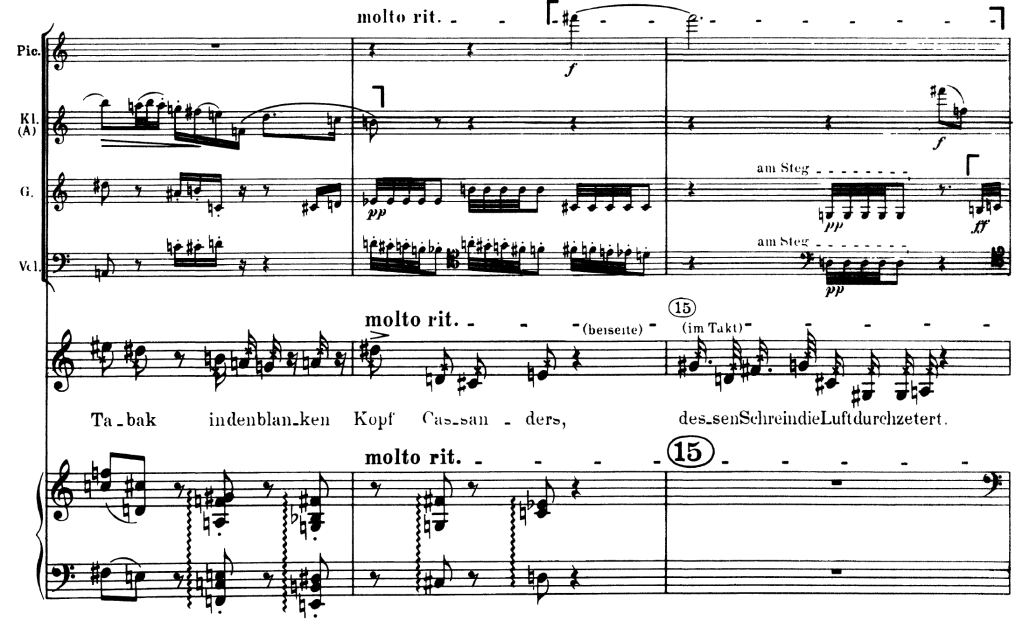
Cassander’s squeal. . .and a donkey, “Gemeinheit,” mm. 13-15.

Since Giraud and Hartleben describe Cassander’s squeal in the poem, Schoenberg couldn’t very well leave it out of the music, could he? And there it is in m. 14, that hilarious isolated piccolo F sharp, just before the vocalist tells us what it is (“dessen Schrein” = “whose shriek”). But just as uproarious is the clarinet hee-haw at the end of the next bar, which makes me think of Mendelssohn’s music for Bottom as a donkey in the Overture to A Midsummer Night’s Dream. The section after this all the way up to the end of the movement is consumed with the gruff repeated-note gesture, now exchanged among the instruments of the ensemble. It’s music of movement or activity underlying Pierrot’s sticking in the pipestem and puffing away. But Schoenberg brings back the laugh track razzmatazz (now in the piccolo and piano) for the final words of the poem: big finish; everybody cheers! And what about that note held over in the cello. . .spotlight on Pierrot? Plunks (piano) in the other instruments as lights out? Again, it’s a performance, from beginning to end.

Laugh track once more, and curtain? “Gemeinheit,” mm. 25-27.

15. Heimweh

Sweet and sorrowful – a sigh of crystal

From Italy’s theater of old

Reaches us: Pierrot is so wooden now,

Has become fashionable kitsch.

“Homesickness” is a rejection. Of where we are now, a realization that something about this moment isn’t enough for us, that we don’t belong, that we should go back. “Homesickness” is a longing. For that other place, for a place of fantasy where we know what we know and things are as they are or should be. Giraud and Hartleben had it easy in playing with nostalgie (the title of the French original); however surreal their poetry, it was not an experiment with the substance of language or a rejection of poetic form or inheritance. Quite the opposite: the poems are rooted in inherited poetic form and pull stock from Europe’s storehouse of theater history. Not so with Schoenberg, whose project was one of the most provocative that any single musician has ever conceived or carried out, more profoundly upsetting to the status quo, I would argue, than Joyce’s challenge to syntax or Picasso’s to representation. It is the Everest of early twentieth-century avant-gardism. Can we climb it? Let’s give it a go.

Fuji-san, not Everest, but you get the point (Photo by the author).

If you’ve been reading these entries, you’ve likely gathered a few things from my approach in “blogging the 21 movements of Pierrot lunaire,” but I should perhaps name a few of them. First, I’ve refused to be intimidated by Schoenberg’s accomplishment, because it is intimidating, particularly if one is driven to understand (at some level) the composer’s musical language on its own terms. But if we act that way toward it, it can only exist at a remove, and I want to hold it close in the mind and ear. Second, I wanted to accept Schoenberg’s invitation to embrace a radical creativity, to play fearlessly in the funhouse that he opens the door to. That has meant trying out different media, trying out different tones in my writing, fostering a fruitful inconsistency within a consistent form. Third, I wanted to focus on a variety of analytical approaches, including ones that would be widely accessible (as opposed to, say, highly specialized pitch analysis). I could mention a few others, but these three are most relevant.

A crystal sigh, the sweet lament, the marionette clicking – all before the words! “Heimweh,” mm. 1-2.

And now it’s the third paragraph, and I’ve yet to say anything about the music of “Heimweh,” which opens the third, and in some ways most complicated, part of Pierrot. I wonder if you’re longing for another place by now? I wonder if I am. Longing for the days, just days ago, when I could write about moon-wine-light or black moths (butterflies!) or sparkling rubies on coffins or even crosses. But now we’re grown up, in a land of confusion, and we’re torn between this and that. What does it mean, Hartleben (and Giraud), for commedia dell’arte itself to send out a krystallnes Seufzen, a “crystalline sigh,” a lament that Pierrot is not relevant or only relevant because he’s irrelevant, a meme of forgotten origin in a sort of ennui-infested kitschiverse? What does it mean, Schoenberg, to layer, thrillingly but overwhelmingly, the sweetness of the violin line with the marionettish clicking of the clarinet and the piano’s evocation of the mysterious “crystal sigh” (before we’ve even heard a word from the vocalist) in a texture that is shockingly new, the opposite of nostalgic? Are you rejecting rejection, Schoenberg? Unboiling the egg, un-meming the meme, unkitsching the kitsch? Are you un-homesick?

Self assertion? The cellist furiously rejects. . .homesickness? “Heimweh,” mm. 28-31.

14. Die Kreuze

Poems are the holy crosses

That poets bleed out on,

Blinded by the vultures

In phantom flapping flocks.

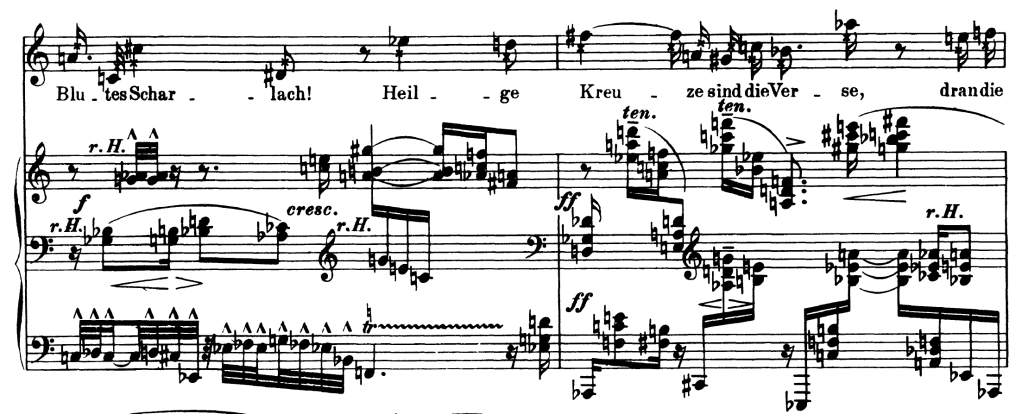
In the wake of Pierrot’s beheading, this last song of Part Two zooms out. Now we see everything from a great distance, are asked to reflect. Pierrot, without a trace of irony, as my ears hear it, has become the Christ-as-poet, crucified for and on his art, and our vocalist gives a homily. It reminds me of the framing pair of narrators in Benjamin Britten’s Rape of Lucretia (1946), who are given the task of making sense of the tragedy at the heart of that opera. I think one reason I make the link is because in both pieces the music makes the shift from action to reflection – it no longer feels like mickey-mousery, as has been the case with so much of the music in Pierrot’s Part Two. An immediate justification for this shift is that Pierrot doesn’t get named in the poem – the familiar protagonist’s moniker is missing from “Die Kreuze,” and in his absence, music has the freedom to shift, or the burden of shifting, into other modes.

The pianist’s cross to bear, “Die Kreuze,” mm. 7-8.

The first of these “other modes” haunts the piano. Voice and piano may seem to suggest art song, but Schoenberg’s writing for the instrument in the first section of “Die Kreuze” is orchestrally conceived: thick, spiky gestures detonate across its range in a way like an aerial bombardment, an impossibility in 1912 that feels impossibly predictive. Think of what it must require to play the over 50 notes, many of them in trichords that continually shuffle their intervallic content, in m. 8 alone. There is a preference throughout for a trichord built on a tritone plus a perfect fourth (E-flat, A, D, for example), but if that’s a referential sonority, it keeps coming in and out of focus in a way that defies prediction. If there’s a deeper logic of succession, a Messiaen-like pattern of sonority, understanding that intellectually would not, I imagine, make a great deal of difference when it came to playing the thing. For all that complication, Schoenberg doesn’t miss the opportunity to paint: the fluttering wings of the phantom scavengers (echoing the light-obscuring moths from No. 8), the flowing out of blood (echoing the moon-scimitar of No. 13, anticipating the red sun setting), and arguably an assortment of other poetic images in this, the cycle’s pinnacle of expressive pianistic excess.

Fluttering of ghost-vulture swarm, “Die Kreuze,” m. 5.

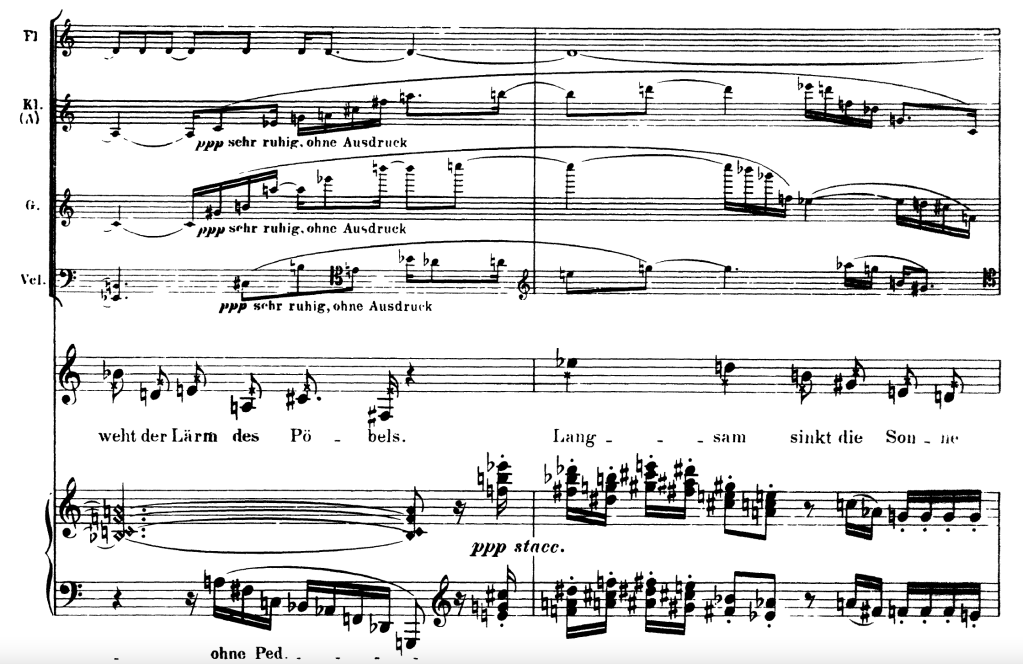
I hear a structural echo of “Enthauptung” in “Die Kreuze,” with an assertive (and yes, violent) first section yielding to a contemplative one. Almost as if the impact of No. 13 sends a ripple – crest and trough – through No. 14. And as the piano rode the wave, so the quartet of other instruments joins in the wake. I hesitate to use the overused word, but I can’t resist: This music, this second “other mode,” is epic, as in Ben-Hur, as in The Ten Commandments. Filmic, cast of thousands. There’s the vision of the body on the cross, harmonics ringing in the piano from the depressed but not sounded keys, ghost tones. But the thing that gets me, that slays me, is the “distant commotion of the commoners,” whose noise is raised by clarinet, violin, cello, ppp, “without expression,” and its transition into the sinking of a red sun over two eternal measures into the trilling night. The clarion calls in the clarinet, bell raised à la Mahler. Darkness falls. It is finished, abandoned to vultures.

Epic moment, cast of thousands from a distance, “Die Kreuze,” mm. 13-14.

13. Enthauptung

The moon, a glinting scimitar

On a black silk cushion,

Ghostly great – glowers down

Through a night dark as pain.

The unlucky number. Schoenberg had no choice, did he, but to put Pierrot’s execution by crescent-moon-scimitar thirteenth in the cycle. Twelve lucky pitches in the chromatic scale, lined up in a row – thirteenth pitch out. One shy of a twice-seven cycle. Wouldn’t leave the house? Born on 13 September, died on 13 July. Would number measures 12a and 12b? Dreizehn. He’s for the chop. I’ve made too much of it? After all, Pierrot merely imagines that the moon-sword slices him: Er wähnt. And yet it’s all been building up to this in Part Two. The moon absents itself, obscured by the papillons noirs, after which laughter is slain, there’s a grave robbery gone wrong, Pierrot rips out his own beating heart, he debases himself in a gallows song, and now. . .this. The inevitable consequence. End of the line.

Cello-hero, prophetic light-blade, “Enthauptung,” mm. 1-3.

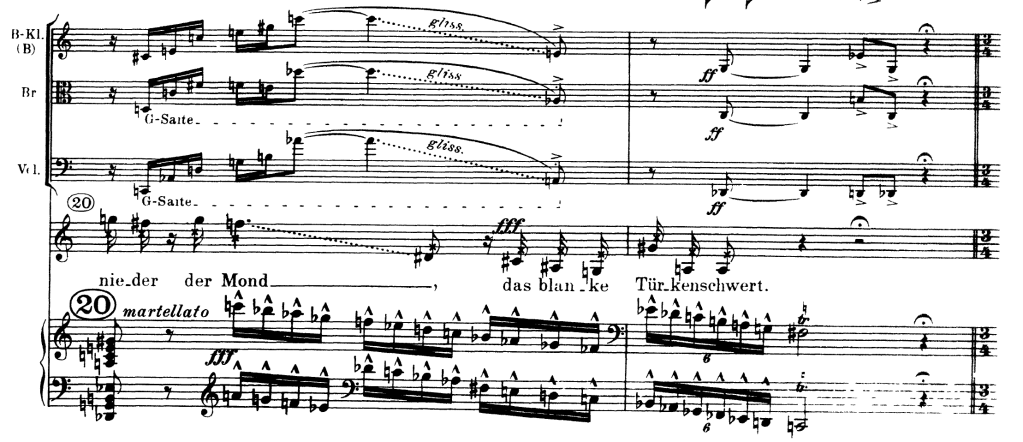
The surface of the movement is strikingly varied, its climax carefully prepared. I wonder things: Now the cello, swept up in deranged lyricism, reveals itself as the Schoenberg-protagonist. Male cello hero, Beethovenian Eroica of cellists, Straussian Quixote of the windmills. And, at the cello’s height, a hint of moon-blade falling – legato in the bass clarinet, not yet fierce enough: a prophecy. We return to a recitative-like strategy when the voice enters: We must hear these words, must get the joke, and yet Schoenberg can’t resist a queasy lurch to fff in the band for gespenstisch groß (“spectrally massive”? “ghostly great”?). Now the bass clarinet anticipates, eliding the last line of the first stanza with the next action: Pierrot darting about, restlessly, driving himself crazy as the instruments build up their densest layer of hyperactivity yet – leading-leading, straining-straining, pointing-pointing. Now violent, explosive, he falls to his knees, the vocalist spewing out a frantic stream of syllables until the scimitar of light falls, glissandi scattered over the accented descent in the piano, all of them traversing different distances, arrows pointing downward at skewed angles. Bounce-bounce. The head plops, like at the end of “March to the Scaffold.”

Fall of the moon-blade, and the Berliozian punchline, “Enthauptung,” mm. 20-21.

And now the head is separated from the body, without form and void, darkness upon the face of the deep. For the first time in the movement the flute enters, intoning a shortened version of “Der kranke Mond” (No. 7), this time with polyphonic dance partners. I’m reminded of a Renaissance mass movement – a paraphrase mass, the old familiar tune adopted, adapted, in the other voices. No. I’m reminded of Beethoven’s late quartets in what is, after all, a quartet epitaph, or else the vocal quartet in the final movement of the Ninth Symphony. No. I’m reminded of the funeral scene in Bruckner’s Seventh, the heart-in-your-throat farewell at the grave of Wagner. No. It’s the final page of Mahler’s Ninth. He’s launched us into space, Schoenberg. We’ve crossed the event horizon and passed through the black hole. The textless, headless moment has opened up a vaster field of reference than we can say. We can’t say. Grain of sand, note beyond the twelfth note, torso sans mouth, signifying statuary with smashed brow. It’s from here that we see the poet’s Golgotha.

Quartet as all, “Enthauptung,” mm. 22-26.

12. Galgenlied

The scrawny whore

With scraggly neck

Will be his final

Paramour

And what should one say after such a quatrain? “Galgenlied” may seem calculated to offend, but in the decade after Strauss’s Salome (1905) and in the immediate aftermath of “Red Mass,” perhaps it’s a mistake to focus on that quality. In terms of the narrative of Part Two of Pierrot, Schoenberg has led us through a series of crimes and now anticipates Pierrot’s execution in a hasty administering of mock-last rites. And this rite – by far the shortest movement of the work, denied the resonance of the piano, with the text compressed to the utmost, the vocalist breathlessly motor-mouthing it – is, as the title might suggest, a bit of gallows humor. Essentially colorless except for the, um, fountain-like burst of piccolo in the penultimate bar, followed by the littlest post-cadential shudder – it is the opposite of erotic, a pitiful instance of Rothian self-abasement. And the shock of this musical negation after the excess of “Red Mass” presents a juxtaposition of extremes worthy of late Beethoven.

The vocalist as motor-mouth, “Galgenlied,” voice, mm. 1-3.

As with “Gebet an Pierrot” (No. 9), Hartleben practiced some powerful contraction on Giraud’s original. The first line above is “La maigre amoreuse au long cou” in the French, which becomes “Die dürre Dirne / Mit langem Halse” in German. I count these as, respectively, ten syllables over one line versus ten syllables over two – the French is halved. Hartleben, with his post-Wagnerian orientation, gives us a strikingly alliterative phrase that seems to disavow any possibility of tenderness. Nor is a hint of tenderness (amoreuse, after all) all that Hartleben excised from the original French. The missing parts of Giraud’s poem are by turns strange, wistful, and, at the end, explicitly sexual: Schoenberg’s parting shot with the piccolo has ample justification in the French. This brings up the interesting possibility of the composer restoring something missing from Hartleben.

The piccolo has its moment, “Galgenlied,” mm. 12-13.

This is the second time in this brief entry that I’ve mentioned absence or negation. It’s worth a third mention as a way of opening a can of worms that I can no longer avoid. I’ll put it as a question: Is Schoenberg’s musical language ever a language of negation – a matter of avoidance, of choosing against? In many cases the answer is obviously no. The pitch logic of “Nacht,” the repetition of meaningful gestures that sound out the text, or of compelling sonorities for whatever reason – in none of these approaches do I understand a spirit of negation. However, in a movement such as “Galgenlied,” deliberately trimmed of all fat, how do we understand what the composer is doing with pitch? I don’t say rhythm, because the rhythmic accumulation and release over the course of the movement couldn’t be clearer, but is the underlying impetus for the choice of pitches (beyond a preference for the major 7th) based on a pattern of denying pattern? If so, in this movement, Schoenberg’s embrace of a method of compositional negation parallels the self-negation also emphasized by Hartleben. That is, Schoenberg seems to be taking his cue for how to compose from the state of the poetic protagonist. But blink and the moment’s over.

Composing by negation? Pitch un-logic, “Galgenlied,” viola and cello, mm. 1-3.

11. Rote Messe

At a gruesome Eucharist,

In a dazzling golden shimmer,

In the flickering of candles,

He nears the altar – Pierrot!

And now we arrive at the Indiana Jones and the Temple of Doom moment, when Pierrot-as-priest pulls his own heart from his body to offer it up to us, his terrified congregants. I remember misunderstanding this movement when I first listened to Pierrot many moons ago – I thought that the violence of the movement was directed outwards, that Pierrot was attacking a priest. (Probably John Williams’s fault. . .) But Giraud’s French and Hartleben’s German leave no room for doubt: “Son coeur entre ses doigts sanglants”; “Sein Herz–in blutgem Fingern–” It’s self-sacrifice, the recurring theme of Pierrot-as-martyr, the pitiable mime, here leaping over the line of good taste in this mock-tragic liturgy.

The candles flicker in “Rote Messe,” mm. 1-2.

The intensity of Schoenberg’s musical language could hardly be greater given the ensemble; indeed, it’s difficult to imagine any composer alive in 1912 finding a richer, more inventive, more fascinating compositional solution to this moment. To a certain extent Schoenberg may be echoing the overall design of the first part of “Mondestrunken,” but instead of moon-wine-light tinkling in the piano, now it’s the flickering of candles off Byzantine friezes. As in “Mondestrunken” there are four exact repetitions of the light figure with a fifth that elides with the next idea, so in “Rote Messe” there are six exact repetitions with a seventh eliding with the next idea. And as the climax of “Mondestrunken” inhabits the movement’s central section, permitting a (relatively) long denouement, so it is in “Rote Messe,” with the moment of horror arriving early as Pierrot’s hand “rips through the priestly vestments.” It’s an unforgettable moment in the score: Schoenberg turns the flutter up, with the gesture of the flickering candles transformed as the bass clarinet, viola, cello, and piano trill furiously, fff, ripping through a riff that circles the trill and then returning to it. The vocalist shrieks at us to identify the gesture: “zerreißt” (“rips”) – also fff and slicing across her central octave, landing as the rending begins in the instruments. There’s an almost Newtonian logic to the downbeat in m. 12, the force of the vocalist’s impact so great that it sends another rip upward through the piccolo to a radical destination high above the other instruments’ ranges.

Let ‘er rip, “Rote Messe,” mm. 11-13.

You can hear all that yourself – don’t need me to tell you, do you? – although it’s salutary in a work such as Pierrot to take time to meditate on all the minor miracles. But I want to ask you one more favor: to take a look at a subtler moment from one of the cycle’s most unsubtle movements. Schoenberg repeats a word. It happens in mm. 21-22, and the word is bangen (“frightened”). The poor souls witnessing the self-sacrificial gorefest – even we – are “bangen, bangen” and not just “bangen,” as Hartleben would have it. It’s a Schubertian bit of willfulness on the composer’s part, something exceedingly rare in Pierrot overall, and something that endangers his argument in the prefatory notes that “the mood and character” should not derive from the words “but always solely from the music.” And what does it mean to be doubly frightened, we wonder? Mea culpa, mea culpa, mea maxima culpa. . .

Not just bangen, but bangen bangen, “Rote Messe,” mm. 21-23.

10. Raub

Royal red rubies,

Bloody drops of faded glory,

Slumber in sarcophagi,

Down there in the crypts.

Now Pierrot embarks on the series of misadventures that will propel him toward the guillotine of No. 13 (“Enthauptung”). In the darkness – the obscuration of light brought about by the monster moths of No. 8 (“Nacht”) – we have a cluster of “crimes”: the loss of laughter (No. 9), an attempted grave robbery (No. 10), the infamous “red Mass,” a pre-execution visit to the brothel. I’m characterizing this string of movements in this way to try to get inside the narrative implications of the ordering of the poems, one of many magnificent things Schoenberg accomplished when he wrote Pierrot lunaire. The moral light snuffed out, this series of crimes leads to punishment and a vision, in No. 14, of the poet-martyr on the cross. To have pieced together this Ming vase from Albert Giraud’s original set of fifty shards and fragments is at least as willful as various slightly dubitable translations offered up by Hartleben (or, more recently, by me)!

A Habsburg ruby, entombed in Vienna (detail), photo by the author.

One of the most fascinating things about this particular crime – “Theft” – is its radical shifts of texture, and how those shifts serve, surprisingly, to clarify what the vocalist is saying. Take a look at m. 5, the first moment of its kind in the cycle, where flute, clarinet, and violin sustain a sonority, pianissimo, so that the vocalist can be easily heard in her opening phrase. No such clearing of the air has happened in any of the previous nine movements. And why? Is it because this botched grave robbery – Pierrot and his mates are too spooked to steal anything, it seems – is so much more worthy of attention than what’s happened before? A risible suggestion. For the sake of textural variety alone? I admit that this is an attractive solution in a work of such limitless creativity. Is there a third way? Perhaps by using recitative and making way for the singer-actor to tell her story, a quasi-operatic ploy, Schoenberg is drawing attention to the larger narrative element he has imposed on the whole: emphasizing, through the long history of recitative, the inherited musical language of story.

Make way for the recitative! “Raub,” mm. 4-5.

Something else makes me think so, though the proof is a touch more difficult. “Raub” has an instrumental refrain – not merely a motive that returns and is transformed, but a section that features certain behavioral tics and that keeps coming back to anchor and emblematize the story. This “section with certain tics” can be identified by its stream of repeated sixteenth notes, either on a single pitch or toggling between two of them. Were this opera of the 1730s we would call this section a ritornello – an instrumental refrain – and in Handel’s capable hands, for example, it would both give us a hook and capture some central image or emotional posture of the aria text. And so it is in “Raub”: We hear Pierrot and companions’ chattering teeth or knocking knees as they creep into the crypt. But my favorite moment is the final, accelerando version of the ritornello where, along with the shaking and shivering, the strings provide a duet of marvelous Psycho­-like screams in harmonics. Are we laughing? Are we horrified? Both?

Run away! Pierrot and friends freaked out, “Raub,” mm. 16-17.

9. Gebet an Pierrot

Pierrot! My laugh,

I’ve lost it!

That shining image

Has melted away – melted away!

Are you reminded of the Wicked Witch of the West? “What a world, what a world!” There’s so much to this connection – in my mind – that it would take novels to unpack it all. Makeup? Cosplay? To Oz and home again in a big moon-balloon? How much time do you have? All that to say that I wanted to be more. . .willful in my translation of the first stanza above, using “sense of humor” for Lachen, because I weary of Lachen always being translated laugh, although that’s clearly what it is: an action, a thing you do and not the underlying thing that motivates it. Maybe that’s better in Part Two of Pierrot lunaire, which moves from the personal world of Part One to a series of scenes and activities that Pierrot is a participant in. Another way to think of Part Two is as a set of skits, an album of Pierrot’s greatest hits gone wrong. Can you see him in this one? Mock-praying? (“Prayer to Pierrot,” after all. . .) Contorting his face to force a stagey smile, winding up for a guffaw only to collapse in extravagant boo-hoos? Is it funny, this lament for lost humor? Mime-funny, at least?

One of Margaret Mitchell’s designs for Pierrot in transformation.

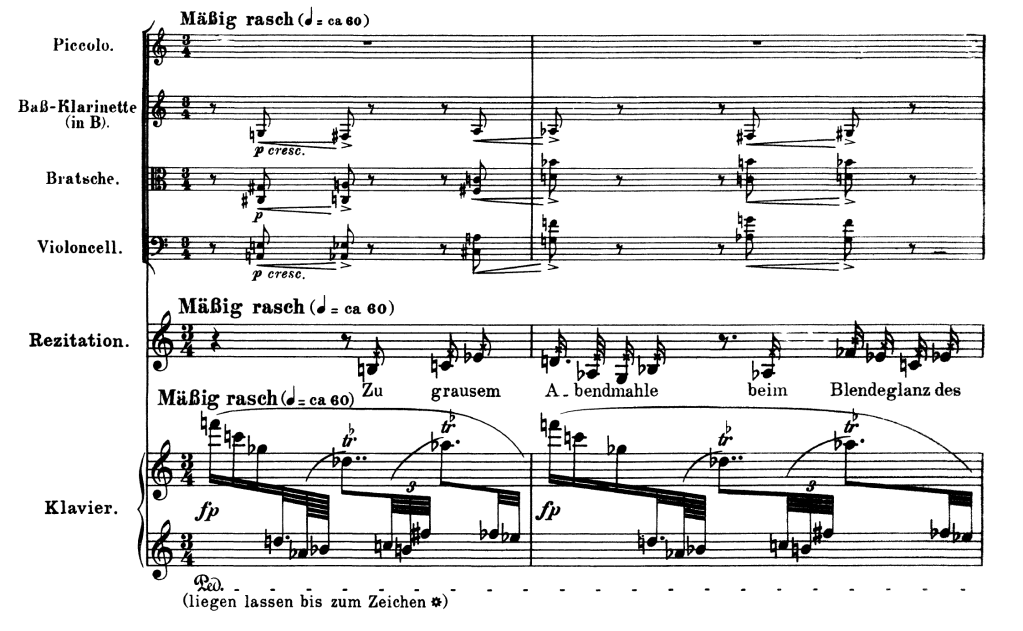
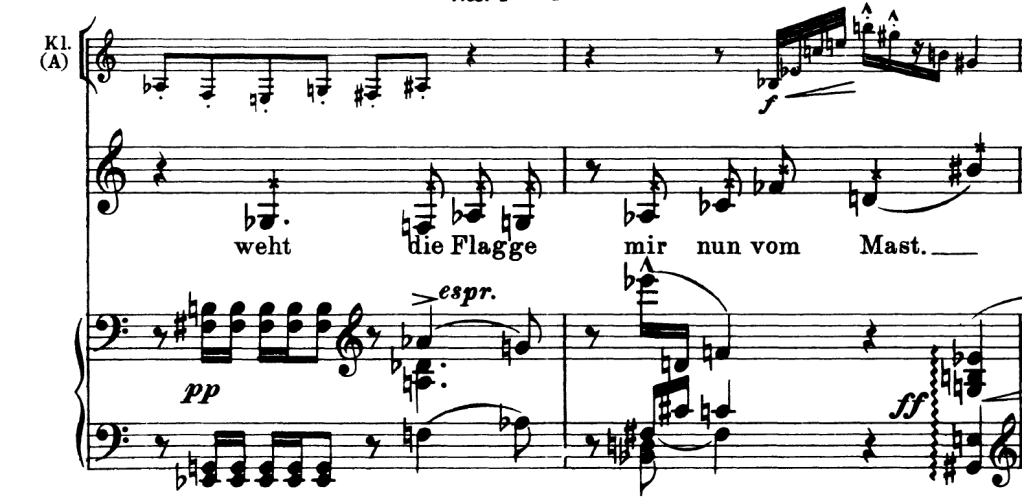
Schoenberg pulls faces, too. He’s performing in every song, each time a new mask with new rules, and hanging over the proceedings is always a question about his own relationship to these words. How funny does he think them? How funny does he want us to think them, given the earnestness of his larger project to “emancipate dissonance”? Where does irony lie? When the clarinet squeaks out – an unforgivable description; I’m sorry – its opening phrase, isn’t it shrieking with laughter, play-acting at the thing that’s supposedly gone missing, like some second character tiptoeing behind you, giving you bunny ears and cutting up for the benefit of the crowd? Or here’s another one, more elusive, that gets me. When the poem turns to the black flag now waving on its mast, what is that curious music going on in the piano? A trumpet tattoo, the back-and-forth flutter of cloth in the breeze, its rippling sent up and down in the clarinet? So much activity, and so varied, for one little mention of a black flag, and Schoenberg gives us an entire maritime scene in mickey-mousing detail. . . He’s mocking himself, or us, or both. Here’s a place where I find myself wanting to see what a singing actor does. Is she tempted to raise a hand, fist clenched around an invisible mini-flag, and wave it like on the Fourth of July? Surely she hasn’t the time to busy herself with such antics. Not with such poetic compression.

The clarinet guffaws at a lost laugh? “Gebet an Pierrot,” mm. 1-4.

Compression itself is another fascinating topic in “Gebet an Pierrot,” because Hartleben’s translation loses a great deal of poetic real estate. That last line of the first stanza? “Zerfloss–zerfloss!” which I’ve translated as “melted away,” but the original French fourth line, which doesn’t even contain the verb, is “dans un mirage à la Shakespeare.” Hartleben lops off half the syllables! Schoenberg has been keen in his musically compact response, but the concision – rushed through, barked and whispered – exists in tension with the “prayer” promised in the title. Here the French title, “Supplique,” might have supplied something more pressing.

A raft of maritime signifiers, “Gebet an Pierrot,” mm. 7-8.

8. Nacht

Malevolent pitch-black moths

Slaughtered the sunlight.

A sealed spellbook,

The horizon is empty, silenced.

The power of “Nacht” – the coup de theâtre it manages – depends on context. It’s always disheartening, therefore, to see it, a stump of a work, in the Norton Anthology of Western Music, Vol. 3, longing for its roots and branches. To have heard the solo flute in “Der kranke Mond” in the previous movement is the essential history of “Nacht,” where, for the first time in the entire cycle, there is no flute or piccolo – no moon-flute-light. We are dropped into the dark that the movement’s title promises. But the world has also gotten larger. In “Der kranke Mond,” we had dwindled away, abandoned by the other instruments. However massive its sick moon, it shone on us alone. Now we are out in some strange world – the upside-down? Mothra vs. Godzilla? – but a world, a vision that sights a void writ in the vastness of heaven.

Moth wing detail (Photo by author)

I’m tempted beyond that which I can bear: as a teacher, I must return to the Norton Anthology. I could do no better – could I? – given my choice of movements than to anthologize “Nacht” and “Enthauptung” (Pierrot’s “beheading” in No. 13). They show Schoenberg exploring two radically different approaches to pitch organization within the same larger work. Moreover, “Nacht” adumbrates, through its motivic games, the serial procedures that Schoenberg would eventually develop, inevitably functioning in the anthology as a kind of stylistic prophecy, I guess. But the thing that strikes me again is the timbral shock: from solo flute in its middle register to bass clarinet, cello, piano, in their lowest. Timbral light is extinguished. And in its absence, Schoenberg draws the circling figure of the mammoth mutant moths – through the three-note repeating figures, through fugal entries, through chromatic descent – circumscribing light and snuffing it out with night-black wings. Ever closing and closing again, closing within closing until a muffled hailstorm of wings fills the skies. No moon. No light.

The cell, the fugal entries, the chromatic descent, “Nacht,” mm. 1-5.

I’m reminded of another piece in the same volume of the Norton Anthology: Ligeti’s Etude No. 9 for piano, “Vertigo.” The way those figures plunge and plunge, cascading over each other to suggest falling infinitely downward, couldn’t have a clearer precedent than in the final passage, tumbling headlong over itself, of “Nacht.” Or sometimes I think the closing page is a ladder, a sort of inverse of Jacob’s, or a journey through Dante’s nine circles, with the batlike level boss roaring and fuming at the center. Whirlpool, tunnel, ladder, or circle, we land in the pit, the bottom of the well. And, now plunged into these dark, unfathomable reaches, what unearthly voices will speak to us?

Infinite descent by ladder, circle? “Nacht,” mm. 22-23.

7. Der kranke Mond

You moon, nightly sick as death,

Up there on heaven’s black pillow,

Your gaze, so massive, fevered,

Captivates me like an unfamiliar song.

It may not seem much of a claim to say that “Der kranke Mond” is singular in a work that features a different deployment of instruments in each movement. Even so. . .it is singular – of twenty-one songs, it’s the only one for voice and a single instrument, and a linear one at that: the flute. (No. 14, “Die Kreuze,” which closes the second part of the cycle, starts with an art song texture of piano and voice, but at a crucial moment gains the full ensemble, on which more later.) Like each instrument in the cycle, the flute (doubling piccolo) has a unique role in Pierrot lunaire. It’s often enlisted, frequently in tandem with the piano in its upper range, to elicit various qualities of light, from beams to liquid light to flecks. And I’m afraid this brings us to the doorstep of a vast domain (Think Bluebeard’s Castle. . .), the question of to what extent the signification that adheres to timbre stays in place, takes part in a cosmogony of sound color, somewhere on an individual-to-cultural-to-universal continuum.

Surly satellite? (Photo by the author).

Hm. Maybe that isn’t perfectly clear. What I mean is: Is the flute, once linked with light, always or even mostly light? And is that because it’s light for Pierrot, for Schoenberg, for Vienna, for “Western concert music,” for humankind, for Rama, or, mutatis mutandis, ad infinitum? And why should that matter? Because it makes the light that might flow from the flute in “Der kranke Mond” a special kind of light, a relationship to a practice of flute-light, one color in a spectrum sparked by the prism of Pierrot. Here I think the case is easier than I’m making it. Yes, the flute in “Der kranke Mond” is light – a wan and morose light, as the poem explains. That moonlight could be this way isn’t surprising, is it? Oppressive, like the planet barreling inexorably toward Earth in Lars von Trier’s 2011 Melancholia. That film, incidentally, uses Wagner’s Tristan und Isolde for much of its score – mostly the Prelude – which aligns with the longing for total annihilation that Kirsten Dunst’s character gives herself over to by movie’s end. Schoenberg does something very different, whittling down the ensemble to just one instrumental voice, as if the everyone else has jumped ship. This sense of abandonment and a consequent collapsing in on oneself is reinforced by some extraordinary expressive markings. I’m drawn to m. 15, where the flute is asked to play pppp, with the vocalist eking out that most Wagnerian of words, Sehnsucht (“longing”), in a counterintuitive ppp gesture that falls into subterranean realms. Listen to ten different recordings, and you’ll realize how unreasonable Schoenberg’s demand is, but it remains. . .an aspiration. How could you perform in that state of self-abnegation – all but absenting yourself as a performer from sound itself? Pierrot has many more surprises for us, but it won’t have anything like this again: a moon so large it fills the sky with its sickness, at the same time a pinprick of light in a field of unfathomable dark.
Schoenberg requests impossible quiet, “Der kranke Mond,” mm. 14-16.

Grotesquely, I’ve gone on too long in the first two paragraphs of my allotted three, so my last comment has to be brief. I hear “Der kranke Mond” in D phrygian, a strangely specific suggestion for what’s supposed to be atonal music. And I like the suggestion, because it is a duet of funereal signifiers: D, the final of the Requiem; Phrygian, the mode of finality.

I’d say it’s D Phrygian, wouldn’t you? “Der kranke Mond,” mm. 26-27.