Whenever I read the middle stanza of “Madonna,” with its description of “ever-open wounds like eyes, red and staring,” I think of Schoenberg’s expressionist portrait of 1910, The Red Gaze. (If you’ve ever looked at the composer’s paintings, you probably remember this one.) When teaching I’ve often asked students whether they understood the painting as sending out a glare – of “wrath” or loathing – or as witnessing something so horrific that it scalds the eyes. To me the mouth in the painting – offen, but wordless; frozen in breathlessness – registers a horror seen, too terrible for description, a moment of trauma so great that it defies the tongue to tell. It burns the eyes going in.
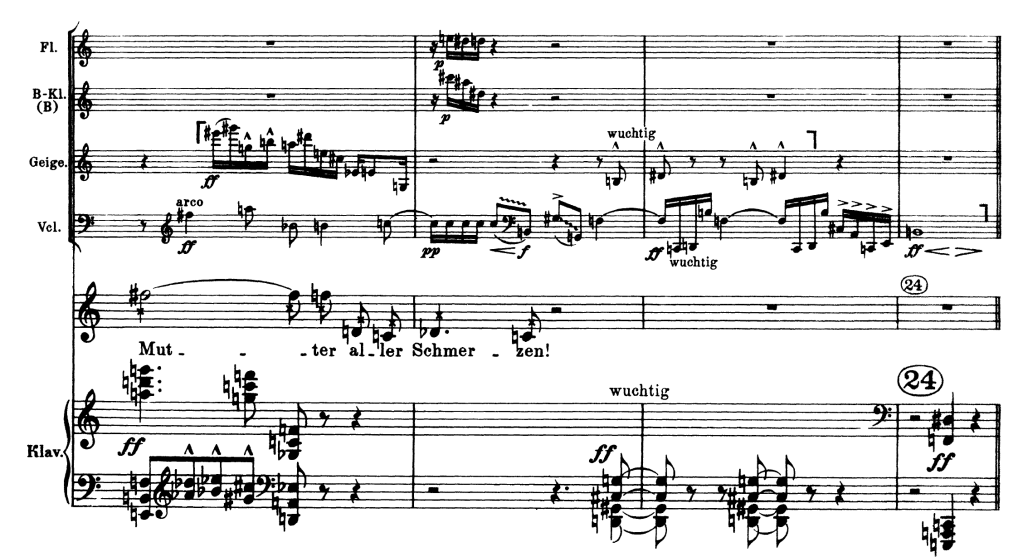
There’s something stunning about how Schoenberg forestalls the climax of his “Madonna,” a movement about the trauma of seeing. Hartleben’s translation is baroque and thick as stew (“Doch der Blick der Menschen meidet / Dich”) and shares the same tick of enjambment as in the final line of “Mondestrunken.” There it seemed to point to the spilling over of the moonwine, as if it cascaded by accident into the fifth line. Here in “Madonna,” it’s different, shockingly so if we’ve been paying attention, because, for the first time, the ritual line changes by a single word. Instead of Steig (“climb up”), it’s Dich (“you”). This change of a single word does happen in several other movements, but the change in “Madonna” seems the most significant: from beseeching Mary (“climb up”) to the pronoun for her (“you”): she has arrived, or we have arrived at her. Schoenberg takes note. Much of the movement employs a trio of instruments – flute, bass clarinet, cello – but for the final ritual line, Schoenberg adds the others. The violin slices a zigzag across three octaves, and the piano detonates its sonic bomb (the wound itself, à la Parsifal?), all while the vocalist sustains, somehow, a Sprechstimme top-line F sharp. The contrast between etiolated weeping-sighing trio and full explosive ensemble gives us Pierrot’s most conventionally dramatic moment thus far. We see her: Mary. We bear witness to her psychic wound, unflinchingly.
The violin slices, and the piano is the wound, “Madonna,” mm. 21-24.
But about that Sprechstimme F sharp. . . One of the other strange things about it – other than the fact that sustaining Sprechstimme on a pitch makes it singing more than Sprechstimme – is its very length: a half note tied to an eighth. This note, on the word Mutter, is the movement’s longest agogic accent, made more dramatic by contrast with the much faster and frankly unrelenting rate of text delivery in much of the rest of the movement. Possibly a vocalist wouldn’t forgive me for this, but it almost seems like she is mumbling for most of the movement or, at best, carrying on an internal dialogue that suddenly erupts into a public declaration in the final stanza. Inner/outer, private/public, hidden/revealed. But what on earth does it have to do with Pierrot? Is Mary’s wound one of convenience, capitalized on for self-pity’s sake? Or is the proposal that this is the wound we must understand to gain wisdom: the Ur-wound, the sign of signs at the center of history? Back to Wagner. . .
Our Lady of Sorrows, Iglesia de la Vera Cruz (Salamanca, Spain) [Creative Commons]
The waltz is dead. Love live the waltz! Waltz-death, love-death, wild chords of passion, tarantella with blood-lipstick. Here’s where things. . .go off, where what had been a little strange, fantastic, or mystical takes a decisive turn toward the gruesome. That it does so with Chopin reminds you – doesn’t it? – of those skull-stacked catacombs stretching beneath the streets of Paris, or perhaps of that famous photo of Fryderyk, our consumptive Polish exile in the cholera-infested City of Lights. And yet there he is, dancing – whether in the salon or with les polonais – floating, gossamer, in the moonlight. Dancing to his death.
The famous daguerrotype of Chopin by Louis-August Bisson.
We were warned. The vision of eine blasse Wäscherin (“a waxen laundress,” I suggested) removes whatever comfort we had drinking moonwine or musing about Colombine or what makeup to wear. That washerwoman – nameless peasant? mother? – wrests us away, forces us to look away from ourself, from Pierrot. We look out at her, at her thankless task – the fathomless abyss she plunges her arms into, the bleak and mournful chorale chords of the opening stretching out, beyond, into the deep. The piano was absent in that place, and it will be silent again in nos. 6 (mostly) and 7. It’s more than that. In the first three numbers the piano was participant in the ensemble, doing what the other instruments were doing – painting the picture, drawing out the text, or (if you prefer) contributing to the richness of Schoenberg’s atonal idiom at its freest and most inventive. Not so in “Valse de Chopin.” Now, for the first time, isolated by its absence from surrounding movements, the piano becomes a character, or perhaps a presence, through its sheer sound and also, wryly, through flashes of waltz idiom and perhaps the occasional musical pun. Most obviously, in the final two bars, the repeated A sharp I hear as a through-the-looking-glass version of the repeated B flats that launch Chopin’s Grande Valse Brillante, Op. 18. Not a direct copy, because Schoenberg wouldn’t, but playfully respelled, retaining the hemiola effect of the original, and transported to the end of the movement – manifold topsy-turveyism.
My ending. . . (“Valse de Chopin,” mm. 40-44)…is my beginning (Chopin, Grande valse brillante, Op. 18, mm. 1-4)
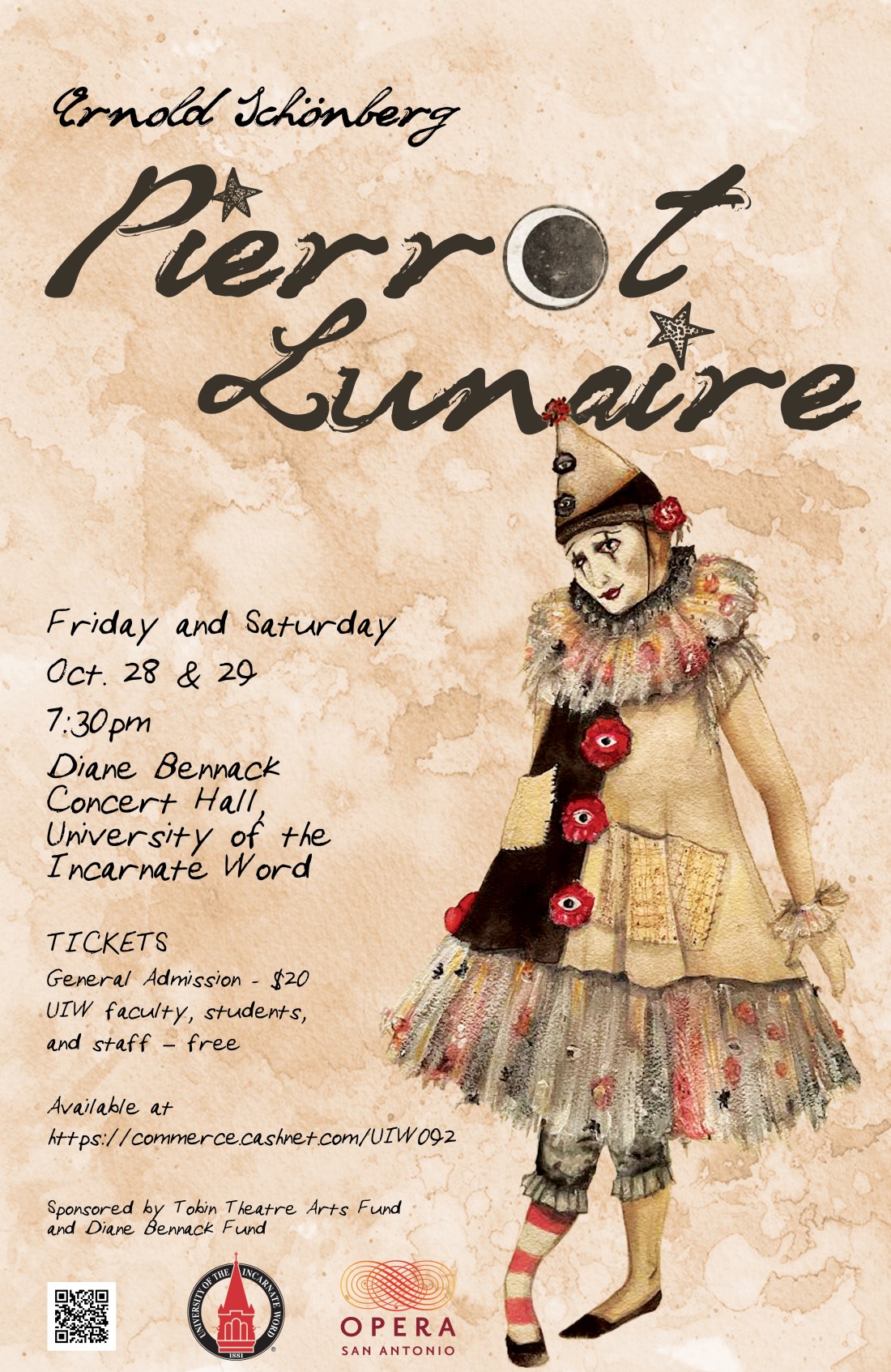
There is something more here, though, in the reference to Chopin’s waltz. Yes, the repeated A sharps suggest a distorted quotation, but more immediately they are a distilled presentation of the Tropfen Bluts (“drops of blood”) that are part of the language of the movement from the vocalist’s first phrase. Schoenberg is creating a sort of imagistic trope on top of a borrowed rhythmic gesture – looking for drops of blood in Chopin’s music – in a way that shoots the listener backward and forward in time, a musical malady. “Melancholy, gloomy waltz / You won’t leave me alone! / You’ve taken hold of my mind,” goes the poem. And this a year before Proust’s Du côté de chez Swann, where the title character also hears a tune obsessively, a musical marker of another self-destructive obsession. Oh, you just have to hear it. . .and you can, on October 28 and 29, 2022, in San Antonio, Texas.
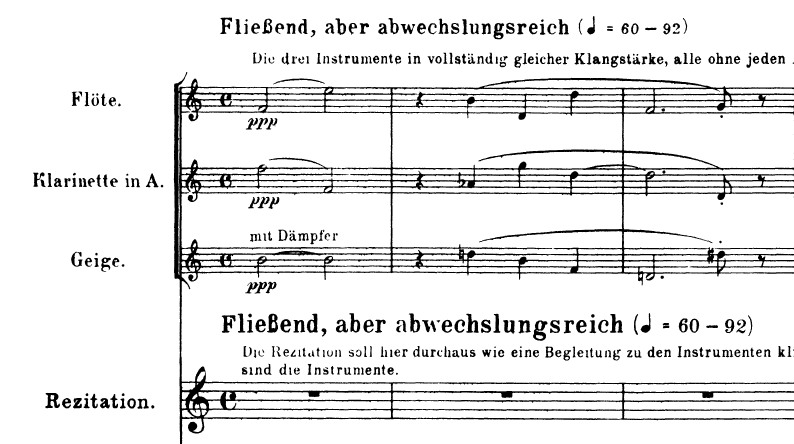
It is a deep current, a high-tide of interpretive possibility, that Schoenberg invites us to in Pierrot lunaire. I was reading Jonathan Dunsby’s brief comments about the “pallid laudrymaid” (from his 1992 Cambridge Guide), which, despite the concision, introduce important points. For example, people in German musical circles in the 1910s likely would have seen the opening of the movement as an example of Klangfarbenmelodie (sound-color melody), because the flute, clarinet, and violin don’t follow the voice-leading that the part-writing seems to demand. Look at m. 2 below, where the three sonorities share a common tone, B, which Schoenberg gives to each instrument in turn, so that if you train your ears on the B, your experience will be one of shifting instrumental color. For the rest of his commentary – it is brief! – Dunsby explains that Schoenberg would probably have heard “Eine blasse Wäscherin” as tonal, cadencing in G minor, that stable sonority (with an added ninth, A) repeated four times in the closing bars.[1]
Klangfarbenmelodie in the shift of B from flute to violin to clarinet, “Eine blasse Wäscherin,” mm. 1-3.
The question of when and how tonality is or isn’t present in Schoenberg is significant, of course, but 110 years after Pierrot was written, other thoughts top my list. One has to do with instrumentation. This is the first movement without piano, and it’s the first that lands us in a natural environment – in and around a river, as the laundress washes her bleiche Tücher (bleached towels? faded linens?). Schoenberg’s gone pastoral, aligning what Dunsby called a clear example of Klangfarbenmelodie with the old historical mode of using wind instruments to call to mind the countryside. But this is not a rustic dance or a mock-pastoral mode – nary a trace of rib-pokery in this movement. Instead, its opening hints at a chorale, reverential. The effect is very different, but it reminds me of the opening of the third movement of Shostakovich’s Seventh Symphony. Nature is holy here, or something is.
That something brings me back to the narrative dogging Pierrot’s steps, the promise of a tale told, where what appear distractions are actually essential elements of its unfolding. I’m thinking about how “Colombine” and “Der Dandy” work together – lovestruck and lovelorn – and how “Eine blasse Wäscherin,” which might seem like it comes from outer space and does indeed shift us to the outer space of a rural reality, both begins and prefigures a new focus on an older feminine presence, eventually revealed as a mother. Mary, moon mother; Pierrot as Christ-like martyr. Is she there with her holy chords, washing the funeral wrappings, adumbrating Pierrot’s beheading in No. 13? What shift has taken place in Pierrot’s mind that he has stopped thinking of Colombine and started thinking of that crouched figure, laboring over rags in the dark?
die saufte Magd des Himmels?
[1] Jonathan Dunsby, Schoenberg: Pierrot lunaire (Cambridge: Cambridge University Press, 1992): 37-40.
And just who is the “dandy from Bergamo,” listless at his toilette, rejecting first the red and then the green makeup in favor of moonbeam white? The German is elusive on this point, and English translations typically follow suit. Schoenberg’s title is “Der Dandy,” so the protagonist might arguably be another figure from the commedia dell’arte tradition – Arlecchino, perhaps? – who more neatly fits the descriptor. But Giraud’s poem leaves no room for doubt: his title is “Pierrot Dandy,” and that’s that. It’s a title that belittles its hero at every turn, emasculating him, making fun of him for imagining that makeup could make a difference. If we’re tempted to trace a narrative arc through Pierrot lunaire, “Der Dandy” follows “Colombine,” where Pierrot had longed to strew moon-petals over the object of his desire. Now, dejected, he paints on his mask. Passing over colors associated with his rivals in love, he will remain Pierrot, daub himself with his trademark cake, however painful that is. “Ridi, pagliaccio, sul tuo amore infranto,” as Canio has it in Leoncavallo’s I pagliacci.
This is a good time to mention that my plan to produce Pierrot lunaire was sparked by Opera San Antonio’s forthcoming production of Leoncavallo’s scorcher of a score. I thought it would be marvelous, frankly, to have Pierrot one weekend and I pagliacci the next, and as it turns out, that’s exactly what’s going to happen. The marvelous. For anyone attending performances of both works, I imagine that the redefinition of Pierrot – the “translation” of him by this assemblage of poets and musicians – will prove thought-provoking, especially since only two decades separate the works. This is one of the things that a tradition as rich as commedia permits: the possibility of infinite translations (even when temporally proximate), including willful and misleading ones.
Translation problems from the penultimate line of “Der Dandy”
Here’s one example to stand for the whole. I became a bit. . .obsessed about the “black sacrosanct washstand” (in Stanley Appelbaum’s translation from my trusty Dover score) in “Der Dandy.” What kind of thing must that be? Appelbaum did his best to accurately render Hartleben’s “schwarzen, hochheiligen Waschtisch,” although managing the explosion of hs and schs would give any faithful English translator fits. But take a look at Giraud’s original line: “Sur le lavabo de santal.” That’s santal as in sandalwood, a far cry from the ebony altar that Hartleben conjures. And when I’ve used “sandalwood lavatory” above, then I’m flying in the face of Schoenberg, whose piccolo-spiked, prism-sparking moonbeams doubtless derive from Hartleben’s black-and-white opposition: the washstand-as-abyss against the pale-as-moonlight face paint. To conclude these pensées on “translation,” take a listen to this: “Der Dandy,” in Erwin Stein’s arrangement of Pierrot for voice and piano, with Akane Kudo (voice) and Yumiko Meguri (piano) managing it all sans winds!
The moonbeam gleams and becomes Pierrot’s makeup, from “Der Dandy,” mm. 30-31
A wonder. A miracle? Wunderrosen. That’s how Hartleben translates Giraud’s original “roses de clarté.” I’m trying something a bit different above – “roses of translucent white” – in the direction of the miraculous. The poet pines, longing to collect petals of moonlight, proclaiming that he can be assuaged only by scattering them over Colombine’s brown tresses. Double entendre? Perhaps. But it doesn’t have to be. I was reminded of those petals today, walking along the creek that runs next to Mission San Juan Capistrano, the air alive with migrating American snout butterflies (Labytheana carinenta), the dance of their multitudinous wings a minor miracle.
A little ambient fantasy on those three chords, with butterflies.
But another minor miracle has always captivated me in “Columbine.” Scored for flute, clarinet, violin, reciter, and piano – a unique gathering, as with each of Pierrot lunaire’s twenty-one movements – it features neither wind instrument until m. 33, the moment when Pierrot fantasizes about scattering the petals. To suggest this, Schoenberg loops three sonorities, the record skipping ten times to end where it began – the clock’s hand stilled, an image of petal-counting, eyes-glazed-over, lovestruck bliss. The violin meanwhile carries on in lyrical abandon, dolce espressivo, as it has for much of the movement, in parodic heartache as the poem describes. Those chords, though. . .a minor seventh chord (without its fifth) in the piano, descending; ascending perfect fourths in the flute and clarinet (in A). I’ve loved those blissed-out, petal-plucking chords since the first time I heard them, since the first time I sat down and listened to all of Pierrot. So much went over my head, I’m sure, but those three chords lodged in my ear for good.
Three chords on loop from “Columbine,” mm. 33-34
When the opportunity arose to produce a performance of Schoenberg’s masterwork, my colleague Ken Metz and I thought we should invite composers to submit new “preludes”: inspired by any aspect of Pierrot lunaire, written for subsets of the Pierrot ensemble (vocalist, flute/piccolo, clarinet/bass clarinet, violin/viola, cello, piano), and under three minutes in length. The timeline was short, but dozens of composers submitted. We were able to program twelve pieces, one of them mine: an ode to those three chords, with textures and gestures that point to other favorite moments here and there. It’s a way to pick petals along with Pierrot and to scatter them, too. You can hear what grew from Pierrot in eleven other composers’ sound gardens on October 28 and 29 in San Antonio.
The opening of my ode to the petal-plucking chords, from Petal Pedal Mettle Meddle, mm. 1-4
What do you really know about Pierrot lunaire? Only what you’ve been told? Or did you have a Pierrot-obsessed moon-phase, a craze? Did you drink it in, drink it up, a fine madness? Twenty-one gems – baroque pearl-wonders, each movement a new proposal for putting together sound and image, deeply rooted in the future-fevered past. This is a story, told in twenty-one parts, of a thing that will have happened: a production, staged, of Arnold Schoenberg’s masterpiece, spun from the fabric of Albert Giraud’s poems, translated into German by Otto Erich Hartleben.
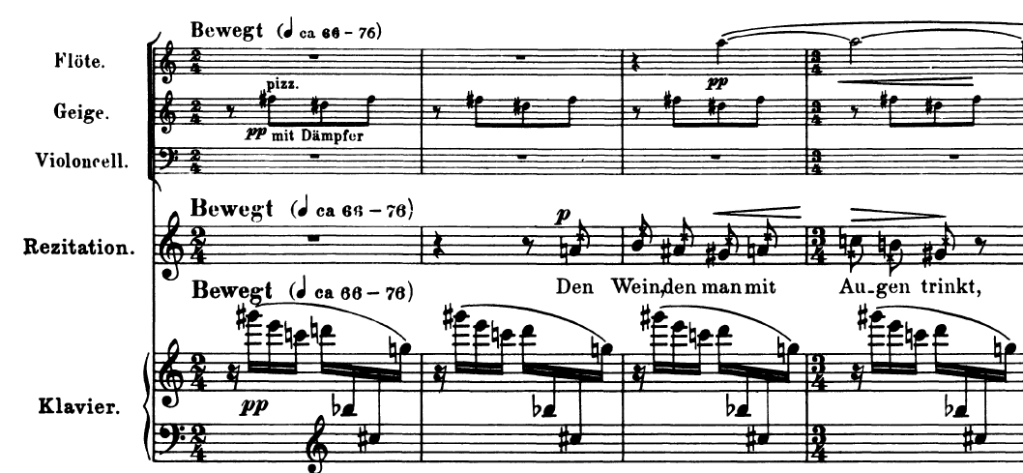
First things first: a form for us. In threes. Each of Giraud’s poems is rendered in three stanzas, and in each there’s the ritual repetition of a line. In each of the twenty-one poems, 3 stanzas: 4 lines + 4 lines + 5 lines = 13 lines. In each of the twenty-one poems, the ritual line is placed first, then third, then last, as if it’s slipping, falling, fallen: first a prophecy, then an action, then a memory and summary. In “Mondestrunken” – “moondrunk,” “drunk with moonlight,” “moon-soused,” “moontoxicated” – the ritual line is, “Den Wein, den man mit Augen trinkt,” which I’ve adapted above to get a triplex of the diphthong “long i.” So, we are warned: Pierrot will drink wine with his eyes. Then it happens: Der Dichter. . .berauscht sich (“The poet. . .gets drunk”). Then, finally, we remember what transpired here in a riot of instrumental color and expressionist vocalization.
Winelight falling in the piano, plunking in the violin. “Mondestrunken,” mm. 1-4.
And that’s what we come back for, isn’t it? The music showing us, bizarrely suggesting to us the world of this bizarre poetry. In “Mondestrunken” Schoenberg shows us as much as he can: the twinkling of the wine-light, falling in the piano, with drops of the stuff plunking in the pizzicato violin. The rush and trilling flute flutter of the high-tide of moonwine, the throaty yearning gestures in the violin sounding the poet’s sweet and gruesome longing. The ensemble eruption of the poet in ecstasy, the strings’ soaring with the poet’s head, lifted moonwards to drink in as much as possible, the grotesque gurgling as it floods the body – that moonwinelight, imbibed through the eyes. This is the first and quasi-prophetic part of the ritual, in anticipation of the staged production – on October 28 and 29, 2022, in San Antonio, Texas, at the University of the Incarnate Word. Full of anticipation, we raise our heads heavenward to quaff Schoenberg’s heady brew.
Sometimes an album
is like a snapshot. Summer 1967: the summer of Sgt. Pepper’s, when the
world of “popular music,” whatever that was, became something else. The snapshot
was of a changing world, a record of kinesis between this and that, the high jump
captured in mid-air, time miraculously frozen. But Sgt. Pepper’s is an
easy example: an album that wanted to be understood as a moment, that knew it
would be a moment before it was one, as the gathered dignitaries on its iconic cover
so memorably demonstrate. (What else could have convinced them to show up?)
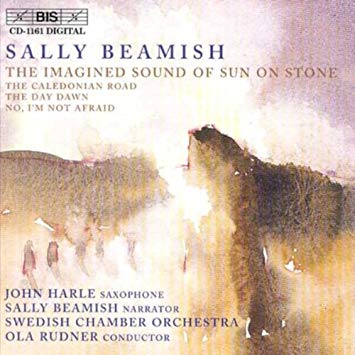
Album cover of Beamish’s “The Imagined Sound of Sun on Stone”
British (Scottish, we should say!) composer Sally Beamish also gives us a snapshot with her album The Imagined Sound of Sun on Stone, which is also the name of the last work on it, essentially a one-movement concerto for saxophone and orchestra. Released after the decade of her meteoric rise (the 1990s) but before her more recent acknowledgment as a major composer of the last quarter century, the album includes works that chart that rise and articulate her compositional journey, a gradual tapping into a deep well of creativity that connects to her identity.
(Nexus entry.)
Felix Femina’s album of Scottish medieval polyphony, with pieces from W1, the musicologist’s bane!
The Caledonian Road (1997), first work on the album, is named after the road in North London where Beamish’s family went shopping when she was growing up. As she explains in the liner notes, the road really was the road to the north – to that place the Romans called Caledonia, the frightful region beyond the reach of Empire. This was also the place to which Beamish moved in 1990, a move described as “the most important of her career.” So The Caledonian Road, while seeming simply to point to Scotland, is also autobiographical and has to do with Beamish’s personal road to Scotland. The sound of the north seems to be present in at least two ways in the work: through a pastoral style conjured by lyrical wind lines over string drones and through specific reference to a complex of musical sources – “ancient bells,” horn calls, and fragments from the St. Andrews Music Book (that is, W1. . .that is, Wolfenbüttel 1, that is, Cod. Helmst. 628, which, as every musicologist of a certain age knows, is one of the major repositories of the Magnus liber organi). Beamish had brought these sources together before in St. Andrew’s Bones (1997), a work for horn, violin, and piano, which was also inspired by the ruins of St. Andrew’s Cathedral in the county of Fife in Scotland, ruins the composer had heard described as “like the rib-cage of some long-dead god.” And so the work is autobiographical in layers, touching on the composer’s childhood and on another work of hers, with its related but distinct set of referents. One of the most unusual qualities of the work to me is its essentially non-dramatic nature. Despite the fact that the largest number of “bell bursts” is saved for the end, the end is really no louder or more impressive than other moments throughout the work. The notes describe the work as being in “variation form,” with variations marked off by those “bell bursts,” combinations of chime sounds and orchestral renderings of bell resonance. Some variations are more active, some more lyrical, and the whole is loosely arranged in a kind of arc shape, with the most active, densely contrapuntal variations inhabiting the central section and the variations with sparser textures bookending the work.
What does such a form suggest if the title points to journey, to a road, and if the notes argue for a sort of narrative dimension where one eventually arrives in a physical and spiritual Caledonia? In thinking about this, it has seemed to me almost as if Beamish structures the work so that the road to the future leads to the past and that the activity of the central section, its agitation, is the movement – a great exertion – that leads back to the beginning. The elliptical journey suggests the preordained, moving forward only to find that the destination was within you, was you yourself in some version you sensed but did not fully comprehend. This is less the unfolding of a drama and more the dawning of enlightenment, the recontextualization of ever-present material.
Reeds near the Budôkan, Photo by Kevin Salfen
The idea of moving into the future to get to the past is also present in the second work on the album, The Day Dawn. Without having read the notes, my first thought was that the saturated, slow-moving string sonorities at the beginning were reminiscent of Górecki’s Symphony No. 3, called the Symphony of Sorrowful Songs because of the texts, concerned with mothers and children, and more particularly with the loss of children. And then I read the notes. Beamish wrote the piece, as it turns out, as an act of public mourning for a friend of hers whose young daughter had died. Perhaps, therefore, Beamish was deliberately referencing Górecki, or perhaps she couldn’t escape him. But the idea running through the piece, of a parent, a mother, trapped in mourning, greeted by sunshine on the day of the funeral after a week of rain, also suggests the world of Kindertotenlieder, and more specifically of “Nun will die Sonn’ so hell aufgehn”: “Now the sun will rise brightly, as if nothing bad had happened in the night.” But where Rückert and Mahler are mired in irony, beset by self-doubt, and Górecki makes grief so beautiful that you never want to leave it, Beamish shows us a way out.
That way is an old Shetland fiddle tune named “The Day Dawn,” which was played to celebrate the Winter Solstice, “to mark the dawn of lengthening days,” according to the notes. The tune is heard at its clearest at the very end of the work, a sort of Ivesian solution to form, as if it could only be pieced together a bit at a time over the course of the work. When it is heard in this clearest version, however, it is without the vim and vigor of dance: a vessel that needs to be filled, the shape of life that needs to be stepped into. And here I’m reminded of another line in Rückert’s “Nun will die Sonn’”: “Du mußt nicht die Nacht in dir verschränken / Mußt sie ins ew’ge Licht versenken!” – “You must not become the darkness yourself but must commune with eternal light.” (That’s my attempt, but I’ve often seen it in English as “you must not enfold the night within you but must sink into eternal light.”) How do you enter into the light that exists beyond mourning? Beamish uses that old Shetland fiddle tune to suggest a potent cure: music, dance, activity, the land, home, the rootedness of those things, their ability to subsume individual grief in a larger story, all of which means that life does go on after loss. It’s a kind of ancient wisdom, the wisdom that has the mother dance all night at a wawa verlorio to mourn her child. To live into the future, Beamish has us travel deeper into the past.
That album that everyone has. . .still good!
Time breaks down
in music, becomes a kind of riddle. Brevity stands for length, forward stands
for backward. We are time travelers, set adrift in a timeless soundscape.
Beamish, as I’ve
said, lets the last work on the album, The Imagined Sound of Sun on Stone,
give its name to the whole. And the way that work plays with sound and time
will now seem iconic for the album and composer. The material, according to the
notes, comes from various places and times: an old Swedish herding call, “psalms
and chants coming from different traditions,” “blues,” though I think this is an
oversimplified way to describe a much more sophisticated jazz-inspired idiom,
which sometimes steams and screams like Coltrane and sometimes simmers and
sneaks like a gumshoe in postwar film noir. Beamish is kind enough to describe
the form of the work in her notes, and I would gloss her description as “accumulation,
arrival, dispersion.” The arrival happens a little over halfway through the twenty-minute
work and is a true climax on an album of few overt climaxes: an explosive, gripping
burst of C major, which the composer describes as “the moment at the solstice
when light enters the prehistoric tomb.” That arrival shatters conventional
time. It serves as a sort of portal into a place where jazz and ancient chant
exist in swirling simultaneity – a universal “hymn” in the Ivesian sense of a
thousand different voices singing their thousand different songs at once.
Gradually the elements released by this C-major arrival, which seems to me a
cousin of the Sanctus from Britten’s War Requiem, scatter and fly away,
but a cycle has been established: seasons flow, and the solstice will come
again, letting past and present dance together until the tomb goes dark.
Irina Ratushinskaya’s most well known work.
The other piece on
the album, I’m not afraid (1989), is also fascinating. An early work,
one that Beamish apparently considers crucial in her compositional development,
it is a sort of response to six poems by Ukrainian poet Irina Ratushinskaya (1954-2017),
which are read (by the composer!) as the chamber ensemble provides an accompaniment
that is part filmic underscore, part expressionistic Pierrot-like
mimesis. The clown logic of the piece may connect to the poet’s history. A
Christian dissenter in the Soviet Union, imprisoned for almost four years, who
wrote poetry throughout her imprisonment, some of which was smuggled out on
scraps of paper: this is the sort of grim grotesquerie that would seem to require
the surreal distancing techniques of Pierrot to achieve anything other
than the bleakest tragedy. I would love to write about Stravinsky in the work,
about the special role for oboe, and yes, about clown logic, but for this entry
maybe it’s just as important to note that in 1989 Beamish was already “singing”
the song of the dispossessed, of the woman imprisoned, yearning to seize freedom.
On this album she has shared that sound of yearning, in her own human voice,
before showing us the ancient destination that lay on the path ahead.
(Nexus exit.)
You see, sometimes an album is like a snapshot. . .
Mayday! May Day.
May 1st. As good a day as any to celebrate beginnings.
Here’s a question for you: What does it mean to write a first symphony? Perhaps for Beethoven it meant self-assertion, a way of setting himself apart from his classical forebears. Perhaps for Brahms it meant living in a world after Beethoven and composing in the company of his by turns inspiring and oppressive ghost. Perhaps for Mahler it meant showing that the symphony had a place in an age of Wagner and Strauss, that it had sufficient epic pull in a concert culture of program music. Perhaps for Bruckner it meant a path toward the divine. Perhaps for Prokofiev and Shostakovich it meant something about returning to the classical origins of the form, reminding a twentieth-century audience that symphonies didn’t have to be hour-long plummetings into the pool of Weltschmerz, although they knew plenty about that. And after the wars? And in the U.S.? Perhaps it came to mean something like. . .self-assertion, at individual and national levels, or living in a world after. . .well, after lots of things—a world of post-ness—or a claim that a first symphony could possess epic pull or was a path to the divine or that it could still manage classical deftness. In fact, it gradually came to mean all those things and more: an overburdened opportunity, and so very irresistible for it, even in a post-symphonic age. I caught the symphonic bug early myself and attempted a three-movement Symphony No. 1, not that anything particularly useful came of it except perhaps an appreciation for composers who could manage it better than I. And it so happens that two fellow San Antonio composers are even now laboring away at symphonies (Brian Bondari, and James Syler, on his second).
(Nexus entry.)
The album I
listened to for this entry contains a Symphony No. 1, of course, a work that
scored the Pulitzer Prize in 1983. Some of the aims of this particular first
symphony are probably similar to those proposed above. Possessed of an immense
lyrical wealth akin to late Mahler or Berg or the agonizing side of
Shostakovich, it has about it the atmosphere of the epic. At the same time it’s
three relatively brief movements taken together clock in at a modest seventeen to
eighteen minutes, terser even than most of Papa Haydn’s. The composer (still
living) was, as the awarding of the Pulitzer indicates, an American, and here’s
where things get more interesting. Does it sound like the great American
symphony, and if so, how?
I heard Ellen Taaffe Zwilich’s First Symphony long ago as an undergraduate but then hadn’t heard it in the intervening (ahem) years until I recently pulled it from the shelf of the listening library in order to revisit what I understood as an important American work in the genre. Zwilich [pronounced ZWILL-ik] was, after all, the first woman to win the Pulitzer Prize in music, a mighty accomplishment in the early 1980s, which, although it was post-many things, was also pre-many others. I speculate that the prize committee heard in Zwilich’s First something that did sound American to them, not in a flag-waving sense but in a finger-on-the-pulse one, and that they also understood that the composer’s accomplishment represented an important part of the American story, as indeed it did and does.
But the thing
that strikes me so powerfully as I return to this symphony is how skillfully
Zwilich makes a Euro-American hybrid. I hear the aching strings of Mahler and
Berg—she was a violinist first, and it shows—but the texture is far leaner,
clear and direct, even Coplandesque at times, primed for effective communication
with a larger, American public. In the liner notes for the album, Zwilich
explains that she had “long been interested in the elaboration of large-scale
works from the initial material.” That might sound like a Schoenbergian way of
talking about what happens in symphonic space, but when you listen to the
opening of the First Symphony, you hear a major third once, then a second time,
then a third time, and that repetition establishes the rising motive that
becomes a theme. This strategy—the straightforward communication through
repetition of a simple initial idea, a germ, that will give rise to the rest—is
more appropriate to Beethoven’s Fifth than to most works with such notable modernist
credentials. Mass communication of classical music, like Texaco sponsoring
broadcasts from the Met from 1931 to 2003, sounds pretty American, doesn’t it?
The opening of Beethoven’s Fifth, isn’t it?
But more is needed to make that communication work than the repetition of an ascending major third, however beautifully varied or artfully orchestrated. And Zwilich does give more. The central developmental section of the first movement doesn’t sound like but is informed by melodic, harmonic, rhythmic, and orchestrational logic reminiscent of the action-oriented music of late-1970s and early-1980s big-budget Hollywood film scores. More specifically, I hear the development section as a cousin of John Williams’s score for Raiders of the Lost Ark (1981). There’s probably more to say about specific connections between film scores and (latent) narrativity in Zwilich’s symphony. Richard Dyer writes in the liner notes that, despite the fact that the composer usually waits for commissions, she began her First Symphony before she had one, and that the “first fifteen bars,” from which “everything in the work arises,” she felt “compelled to write.” Who knows what lies behind this, what it was that compelled her? But the lyrical language of the work, which moves between anguish and repose, opens the door to the narrative imagination. We needn’t walk through. It’s easy enough to accept Zwilich’s work as “absolute music,” and my suggestion about a certain affinity with contemporaneous film scores is about the materials of music: notes, rhythms, and textures. Moreover, these notes, rhythms, and textures link what was going on in the classical season of orchestras in the late 1970s and 1980s and what was going on (or starting to go on) in the pops season. Finger on the pulse indeed.
(Nexus exit.)
ETZ, from the composer’s website. . .
As always, there’s
so very much to say. A work like Zwilich’s First Symphony deserves lengthier
exposition, a rich and nuanced reading: it is a worthy and wonderful work, and
important since Zwilich has to date written four other symphonies. Go listen to
it if you haven’t, or listen to it again if you’ve forgotten it. But this album
contains two other fine works as well—Prologue
and Variations (1984) and Celebration
(1984)—all played admirably by the Indianapolis Symphony Orchestra under
John Nelson. Celebration particularly
fascinated me on this listening, unmistakably evoking the opening of Mahler’s
First Symphony and anticipating the Tarantella movement of Corigliano’s First
Symphony. If neither of those works seem particularly celebratory in those
places, then you’ll understand something of my fascination with the rhetorical
riddle of Zwilich’s title. And discovering for the first time or rediscovering
something fascinating is well worth celebrating.
Again the (almost) random pick leads me home. Last time I listened to Canadian composer Violet Archer only to discover that she had taught at my alma mater. This week I reached for an album of music by Judith Lang Zaimont, who certainly has a place somewhere in the greater pantheon of significant contemporary composers: frequently played, referenced, and commissioned. And the first piece on the album, Wizards, was a commission by. . .wait for it. . .the 2003 San Antonio International Piano Competition. Well, I used to write program notes and give pre-concert talks for SAIPC’s concert series; moreover, esteemed fellow San Antonian Ethan Wickman has recently been commissioned to write the required piece for the Gurwitz 2020 International Piano Competition, the revamped and renamed SAIPC.
Album cover, “Pure Colors: Music by Judith Lang Zaimont”
But back to the album. The pianist for Wizards is Young-Ah Tak, who won the silver medal at the 2003 SAIPC and who manages the formidable challenges of Zaimont’s work with assurance and verve. The liner notes explain that the composition is divided into three sections: Spell CASTER, Spell WEAVER, and Magister – SORCERER. As I listened, I tried to imagine the sort of wizard Zaimont was conjuring with her tracery of ornament and thrumming chords. It occurred to me at a certain point that perhaps different “wizards” of 20th-century keyboard music were being evoked: hints of Messiaen, Ravel, Prokofiev, more distantly Scriabin. But at a certain point Zaimont asks for a pizzicato effect—achieved, I think, by reaching into the piano and using the finger to dampen the string—and instead of suggesting prepared piano it points to a kind of orchestral range of color present throughout the piece.
(Nexus entry.)
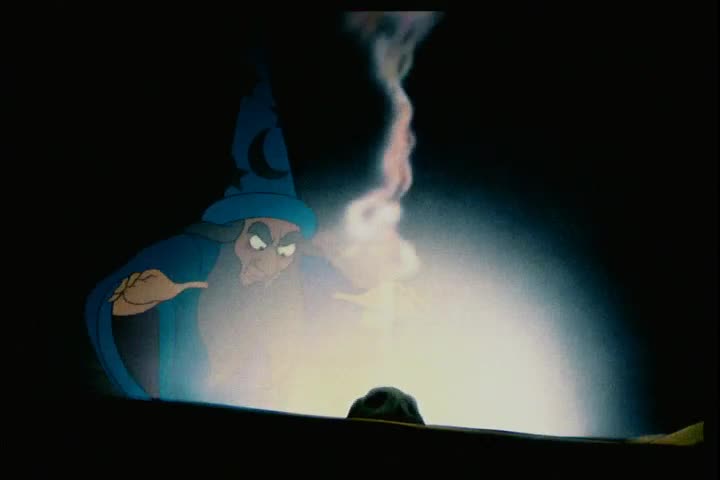
So again, what “sort of wizard” is Zaimont conjuring with her pseudo-orchestral palette? Here I have to preface further comments with an apology and a justification. First, I am sorry for what I’m about to say; it might be a bit irresponsible, lazy, postmodern, self-indulgent, inappropriate, inauthentic, and therefore far from ideal. But. . .a blog should have a certain spirit of freedom, don’t you think? So much for the apology. Now for some justification. Many moons ago at a national meeting of the American Musicological Society I heard a (clearly memorable) paper about George Crumb’s Vox Balaenae during which the presenter made the claim that certain passages in Crumb’s work echoed Stravinsky’s Rite of Spring, an association that resonated in part because of the intermediary of Disney’s classic Fantasia (1940). (Dinosaurs = leviathan = ballaenae?) You see there? I have the AMS on my side. All that to say that the contour of Wizards, from the finely wrought filigree of the opening to the explosive ending, suggested to me not just Dukas’s Sorcerer’s Apprentice, but also the intermediary of that particular sequence in Fantasia, replete with the initial visual hocus-pocus of the sorcerer changing a phantasmagoric bat into a butterfly, Mickey’s later violent axing of the poor broomstick, and the unstoppable flood. Obviously no one needs to hear Zaimont’s Wizards in this way, but I can’t help but wonder if some hazy childhood memory played a role in the creation of this colorful and effective work.
Still from “Fantasia” (1940) – the Sorcerer conjures. . .
Another
association I made as I listened to Zaimont’s album was with ¡¡¡BeNjAmIn BrItTeN!!! In fact, the
association was suggested by two different aspects of Zaimont’s unusual Virgie Rainey: Two Narratives (2002),
written for “soprano, mezzo, and piano.” This suggested to me Britten’s Canticle II: “Abraham and Isaac”, perhaps
for no other reason than that both pieces are narrative in nature and they are lengthy
works, in the art song tradition, written for two singers. The justification
for two singers in Britten’s work is made clear in the title: two voices, one
high and one low, take on the roles of father (Abraham) and son (Isaac). The perspicacious
reader will know that Britten doesn’t always use the voices this way: for example,
Britten uses the two together in close voicing to suggest, gloriously, the
voice of God.
Eudora Welty’s “The Golden Apples” (1949)
The two voices in
Zaimont’s piece don’t have this titular justification, or at least that’s how
it seems initially. Virgie Rainey is a single character in Eudora Welty’s collection
of interrelated short stories, The Golden
Apples (1949). The first narrative is about Virgie’s response to the death
of her mother, Katie. She walks down to the Big Black River, takes off her
clothes and floats there for a while, “always wishing,” after she has returned
to the bank and put her clothes on, “for a little more of what had just been.” The
second narrative, markedly different in character, is about Virgie Rainey as a
pianist – or, rather, about her limits as a pianist. “Für Elise was always Virgie Rainey’s piece,” the section used in Zaimont’s
second narrative begins. The passage then shifts quickly into a description of
Miss Eckhart, Virgie’s piano teacher, and the conflict between them over the teacher’s
“worship” of her metronome and Virgie’s refusal to “play another note with that
thing in her face.” The passage then moves on to Virgie playing piano for the
picture show, “the world of power and emotion,” where she only got to play Für Elise in fragments to accompany the
occasional advertisement.
One might be
tempted to think that the two voices, soprano and mezzo, have been used in a way resembling Britten’s Canticle II: that two characters are being suggested in the two
narrative passages. In the first, the two women could be the mother and
daughter; in the second, the piano teacher and student. But Zaimont hasn’t
written the music this way. Obvious conflict, the stuff of musical drama, doesn’t
exist between the vocal parts; instead, they generally function as part of a single
instrument, a chorus of two. Or perhaps Zaimont is suggesting something about the
simultaneous sounding, through one set of words, of the narrative voice (Welty’s
voice) and the characters (Virgie, Katie, Miss Eckhart) who inhabit the world.
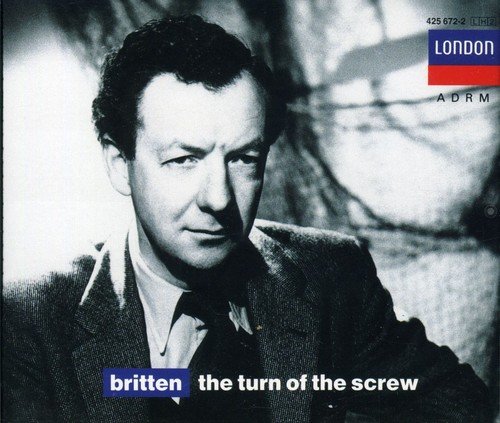
Britten’s “Turn of the Screw” (1954)
But these issues of musical narration weren’t what suggested Britten to me. Instead, it was the weirdly virtuosic treatment of shards of Für Elise in Zaimont’s piano writing for the second narrative. This is out of keeping, of course, with Beethoven’s original and with the idea of a girl playing Für Elise incessantly in rural Mississippi with a piano teacher who wants to subject her to the will of the metronome. There’s a lot of irony to unpack here! Who is the virtuoso? Is the more virtuosic Für Elise an indicator of Virgie’s spirit of resistance, of the magnificence of her Beethoven-like will? Or is the virtuosity authorial: the presence of Welty (and Zaimont) in what is otherwise a mundane, non-virtuosic space? However one might read it, I was reminded of the extraordinary piano sequence in Act II of Britten’s Turn of the Screw (1954), when the boy Miles plays a twisted version of. . .well, what is it, anyway?. . .Mozart? Clementi? Whatever it is, it’s either terrifying or humorous, depending on your mood. Anyway, as Miles plays his sick Mozart, the Governess and Mrs. Grose sing together, “O what a clever boy; why, he must have practiced very hard.” This grouping of a child practicing strange distortions of a familiar (banal) classical idiom and two women singing in a sort of unified utterance is just too close to Zaimont’s second narrative not to mention the correspondence. Of course, Virgie’s “crime” is different in detail from Miles’s, though both are rendered as unlikely antiheros, children defying authority, influenced by some dark and lingering ghost.
(Nexus exit.)
As a final note, it’s well worth listening to the other pieces on this disc, which are all attractive and played well: Astral (2004) for solo clarinet, Valse Romantique (1974) for solo flute, ‘Tanya’ Poems (1999) for solo cello, and ‘Bubble-Up’ Rag, a “concertpiece” for flute and piano. The effect of the whole, in fact, is to encourage one to go searching for works by Zaimont for larger ensembles to see how they relate to her chamber style. Homework for a future entry. . .
Last time I listened to a disc of concertos by R. Murray Schafer, but only after I had scoured the listening library database for every last recording by said Canadian composer. This led me to a 5-disc compilation, Ovation: Volume 2, which does indeed feature a disc of R. Murray Schafer’s music that includes his first concerto, written in 1954 for harpsichord and eight wind instruments. But that’s for some other time. This time I couldn’t resist the first disc in the set, featuring an assortment of pieces by another Canadian, Violet Archer (1913-2000), covering an almost 40-year span, from the Sonata for Flute, Clarinet and Piano of 1944 to the finale from the Sonata for Unaccompanied Cello of 1981.
Nexus entry.
Can I share something about process? I like my first listen to happen before I read the notes. So I listened, not knowing anything at all about Violet Archer or her music. When I got to the Divertimento for Saxophone Quartet (1979), I was struck by what I heard as a debt to Bartók, particularly in the third movement (marked “Festive”). More specifically, I heard one of my favorite movements of the Bartók quartets, the middle movement of the Second Quartet, a barn burner if ever there was one. Then once more, in the final work on the disc, the Sonata for Unaccompanied Cello, I heard echoes of Bartók’s quartets, but. . .what can you do? What young composer, having heard Bartók’s quartets, would not want to seize hold of that inimitable kinesis, that frolic and force and ferocious fire? So I thought Violet Archer perhaps stumbled inadvertently into the shadow of the Hungarian master. Then I read the liner notes. Turns out that Violet Archer, ahem, studied with Bartók in New York in 1942. So there’s that. This was no accidental traipse through a shadow, but the transmission of something tangible from teacher to student. Archer earned her Bartók merit badge.
Similarly, when I heard Archer’s Landscapes (1951), a trio of settings of short texts by T. S. Eliot for choir, I heard something like Vaughan Williams at a distance, or at least that era of British composers, occasionally even in the direction of ¡¡¡BrItTeN!!!. And then the notes. Another of her teachers was Douglas Clarke, himself a Brit, who studied with Vaughan Williams and Charles Wood. Archer was, like Clarke, an organist, and it’s tempting to imagine that the transmission of that early twentieth-century British choral idiom was carried on a current of liturgical music that they both played. Alas, there’s really none of that choral liturgical music on this album, although there is an art-song-like setting of Psalm 23.
And now something I missed. Upon listening to the Sonata for Flute, Clarinet, & Piano (1944), the earliest work on the album, I heard in its sardonic style, its playful half-poisoning of familiar dance idioms, the stamp of Shostakovich. But the notes revealed that her longest period of composition studies was under Paul Hindemith, from 1947-9. And once I read that, even though her study with Hindemith came after the composition of the Sonata, I could now hear an early affinity with Herr neue Sachlichkeit. My favorite thing about Archer’s Sonata? Repeated, and I would say unmistakable, wisps of Sobre las olas (Over the Waves, 1888), the waltz by Mexican composer Juventino Rosas (1868-94) that would eventually be adapted into “The Loveliest Night of the Year” for the 1951 film The Great Caruso, starring Mario Lanza. Not that Archer could have known that in 1944, which begs the question: What’s it doing in there, besides parading around its insouciant self? A little searching revealed that Sobre las olas supposedly had a long association with (fun)fairs in the United States, in part because it was a tune available on Wurlitzer fairground organs. If that’s where Archer got the idea to use the tune – she was an organist, after all? – then its use seems of a piece with the “classic” neoclassical aesthetic set forth by Cocteau in Le coq et l’arlequin, bringing fairs and circuses and machines into the concert hall.
Speaking of concert halls, here’s something else from the liner notes that piqued my interest: Archer’s “Cradle Song” (1949), second in a set of four songs on this album, had its première in 1952 at North Texas State University (now the University of North Texas). Elsewhere in the notes the writer says that Archer was composer in residence at “Texas State University” before moving on to the University of Oklahoma; I can only imagine that NTSU/UNT is what was meant, and indeed there’s a brief bio of Archer on UNT’s website on a page listing former composition faculty. All that to say that Archer, this composer whose music I found when searching for R. Murray Schafer recordings, was professor at my alma mater, taught in the program where I would receive composition degrees some four decades later. And who was one of her students but Larry Austin, who by the time I was working on my degree had become a composition professor there himself. Small world, eh?
When from time to time I’ve thought of Larry Austin (1930-2018), one of the things that most frequently pops into my head is the concert where I first heard his Canadian Coastlines (1981). (Picture eight instrumentalists with headphones, each hearing a different clicktrack, with everything routed through a massive central mixing board, wires strewn all over stage.) The piece itself was commissioned by the Canadian Broadcasting Corporation, and in writing it Austin derived musical phenomena from maps of, yes, sections of the Canadian coastline. As a student I heard an anecdote about the piece where John Cage, Austin’s longtime friend, “seemed enthralled by the piece, and after the performance very enthusiastically said, ‘Larry, it was beautiful; I didn’t understand it.’” [1] I’ve often told that anecdote as a way of illustrating Cage’s aesthetic preference for unknowability, but just this week, through my encounter with the music of Violet Archer, Austin’s teacher, the piece has come to mean something more to me.
For Canada is a presence in several pieces on the Archer album. That presence is perhaps at its most unmistakable in the song cycle Prairie Profiles (1980), for the unusual combination of baritone, horn, and piano. The work was commissioned, like Austin’s Canadian Coastlines, by the Canadian Broadcasting Corporation and was written “in honour of Alberta’s 75th birthday.” Of all the pieces on this album, Prairie Profiles includes the most extreme effects: explosive, terrifying, raw, stark – all qualities that seem worlds away from, for example, the Sonata for Flute, Clarinet, and Piano. Take the first of the songs, “Buffalo Jump,” where a moto perpetuo line in the piano’s lowest range suggests the stampeding of untold numbers of bison as they plunge off a cliff, after which there is simply silence. The combination of mad violence and bleak emptiness, an uncompromising stare into the elemental, reminds me again of The Monk by the Sea, which I mentioned in my entry on Schafer, and of that composer’s The Darkly Splendid Earth: The Lonely Traveler. Here are forces beyond human control, which music grasps in a way that suggests a parallel with Larry Austin’s incomprehensible sonic projection of coastlines. A mystical response to the magnificence of nature informs these pieces. And there they were: Archer and Austin, teacher and student, writing pieces a year apart for the CBC, having been brought together first some thirty years earlier in Denton, Texas, united in their awe before an unknowable vastness and in their attempts to sound out something of that unknowability.
Nexus exit.
But I barely mentioned the Divertimento for Saxophone Quartet (1979), an admirably accomplished work, or the Ten Folksongs for Four Hands (1953), by turns attractive and quirky, or “Red River” (from the choral cycle Landscapes), the piece from the album I’ve now listened to the most. Well. May life provide us all with more opportunities to hear the world’s Violet Archers and to come to understand that they may well have walked the same hallways we did.
[1] Thomas Clark and Larry Austin, “Coasts: On the Creative Edge with Composer Larry Austin,” Computer Music Journal 13, no. 1 (Spring 1989): 21-35.


















 This led me to a 5-disc compilation, Ovation: Volume 2, which does indeed feature a disc of R. Murray Schafer’s music that includes his first concerto, written in 1954 for harpsichord and eight wind instruments. But that’s for some other time. This time I couldn’t resist the first disc in the set, featuring an assortment of pieces by another Canadian, Violet Archer (1913-2000), covering an almost 40-year span, from the Sonata for Flute, Clarinet and Piano of 1944 to the finale from the Sonata for Unaccompanied Cello of 1981.
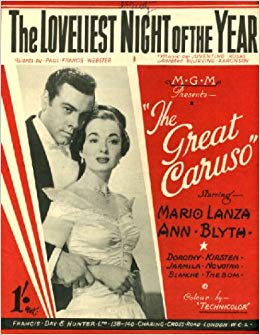 Not that Archer could have known that in 1944, which begs the question: What’s it doing in there, besides parading around its insouciant self? A little searching revealed that Sobre las olas supposedly had a long association with (fun)fairs in the United States, in part because it was a tune available on Wurlitzer fairground organs. If that’s where Archer got the idea to use the tune – she was an organist, after all? – then its use seems of a piece with the “classic” neoclassical aesthetic set forth by Cocteau in Le coq et l’arlequin, bringing fairs and circuses and machines into the concert hall.
 Elsewhere in the notes the writer says that Archer was composer in residence at “Texas State University” before moving on to the University of Oklahoma; I can only imagine that NTSU/UNT is what was meant, and indeed there’s a brief bio of Archer on UNT’s website on a
  (Picture eight instrumentalists with headphones, each hearing a different clicktrack, with everything routed through a massive central mixing board, wires strewn all over stage.) The piece itself was commissioned by the Canadian Broadcasting Corporation, and in writing it Austin derived musical phenomena from maps of, yes, sections of the Canadian coastline. As a student I heard an anecdote about the piece where John Cage, Austin’s longtime friend, “seemed enthralled by the piece, and after the performance very enthusiastically said, ‘Larry, it was beautiful; I didn’t understand it.’” [1] I’ve often told that anecdote as a way of illustrating Cage’s aesthetic preference for unknowability, but just this week, through my encounter with the music of Violet Archer, Austin’s teacher, the piece has come to mean something more to me.
 Sound Trove