
In the last entry I found myself (unavoidably?) making a reference to Beetlejuice (1988), which (unavoidably!) got me thinking about, yes, the score by Danny Elfman (b. 1953), and also the film’s two moments of spirit-possessed dancing, both accompanied by classic Harry Belafonte recordings: “Day-O (The Banana Boat Song)” and “Jump in the Line (Shake, Señora).”  Part of me wants to write this entry on an album by Harry Belafonte (b. 1927): musician, actor, activist. After all, his album Calypso (1956), which opens with that unforgettable “Day-O,” was the first LP to sell a million copies and was #1 on the U. S. charts for 31 weeks. But that’s not the album I pulled from the shelf.
A thorny, troublesome something—an interpretive Demogorgon—lives at the intersection of Caribbean music, spirit possession, and “strangeness” in postwar Euro-American culture. To limit this to the present topic, maybe it goes something like this: The makers of Beetlejuice had seen examples of the Terrifying Dangers of Caribbean Music in movies and TV shows growing up, and the terror thrilled them.
 Think of the use of calypso in the 1962 film Dr. No, the first Bond movie featuring Sean Connery as 007. In the opening sequence, a trio of (Chinese-Jamaican) assassins, feigning blindness, gun down the British agent assigned to the Kingston office in broad daylight and then melt back into the cityscape. Their soundtrack is a calypso rendition of “Three Blind Mice,” realized by Monty Norman (who penned the Bond theme, etc., John Barry, etc., legal action, etc.). This sounds ironic, menacingly so, and given Monty Norman’s fascination with Caribbean music and his work with Jamaican musicians, the composer probably meant it that way. But I’m not so sure that the children who would grow up to make Beetlejuice would have. Here was musical otherness paired with racial otherness, all supporting a delight in violence. What child could ferret out the ambiguity, even with the words of a children’s song there to drive it home in a sort of calypso echo of the slow movement of Mahler’s First Symphony? Instead, there’s the simultaneity of horror at and liberation from conventional mores, precisely the heady mixture characterizing the possessed dance sequences in the Tim Burton film. There’s nothing particularly unusual about this idea: It’s exoticism, simply put. What makes the phenomenon so memorable in Beetlejuice is that exoticism undergoes a kind of emptying of its original foothold in reality because of the disembodied nature of recording and the imprecision of nostalgia for a remembered childhood.
 This reminds me of the opening of Simon Winder’s The Man Who Saved Britain: A Personal Journey into the Disturbing World of James Bond (2006), where the writer recalls seeing the Bond film Live and Let Die at the local cinema as a ten-year-old. He makes himself sick with a rum-and-raisin-flavored candy bar called an Old Jamaican while watching “voodoo worshippers. . .screaming and convulsing” in a “loosely West Indian setting.” Gross. As Winder realizes of his adolescent self. Of course, there is an irony in that Jamaica was the very place that Ian Fleming wrote most of the Bond novels; it was his second home, and he clearly loved being there. And yet. . .empire, colonialism, racism: the ugly, inescapable past that anyone with a conscience must perpetually face down.
And now for something (sort of) completely different. (Nexus entry.)
There’s much to love about Nonesuch Records. Nonesuch commissioned—yes, commissioned—Morton Subotnick’s Silver Apples of the Moon (1967). (That’s enough, isn’t it?) Under the visionary leadership of Teresa Sterne (1927-2000), Nonesuch released recordings by a number of important young composers and also an Explorer Series, featuring music of stunning variety recorded on site around the world. Sterne and her team at Nonesuch in the late ‘60s and early ‘70s seem to have appreciated that, in the spirit of the times, expanding minds meant expanding sonic experience into realms of the unfamiliar.
One record in Nonesuch’s Explorer Series—the one I did pull from the shelf—is The Sound of the Sun (1967), an album comprised entirely of music for steel band (as in steel pans) played by the Westland Steel Band. A brief essay by Jane Sarnoff on the back cover sketches a history of the steel band, an ensemble born of extraordinary resourceful in the wake of repeated attempts by colonial authority figures to clamp down on aspects of Carnival. Drums in the nineteenth century? Banned. Bamboo sticks thumped on the ground? Banned. Pots and pans, discarded brakes and other metal bits were promising, but then. . . As Sarnoff puts it, “There are countless rumours, calypsos, and stories telling of the One man, the thousand One men who first discovered that dents in the tops of steel drums made notes.” She continues delicately, “The large oil industry on the island gave a ready source of basic instruments.” Helen Myers (ethnomusicologist alert!) is less conciliatory in her 2001 article for Grove: “After World War II, bandsmen developed a technique whereby the discarded American 55-gallon oil drums littering the island could be fashioned into a tuned idiophone whose tempered steel extended the range of musical versatility of their groups.” So Americans leave massive amounts of toxic waste on an island in the Caribbean, wash their hands of it, and the people of Trinidad give the world the steel band.
 The gift of The Sound of the Sun, though, is that it reveals an ensemble in transition. Not too long ago someone shared with me a YouTube video of a steel band playing the opening of Rite of Spring. It was meant to impress, and it did, as if to say, “Anything an orchestra on a concert stage can do, we can do.” That claim could not have been made when the Nonesuch record was made. In 1967, steel bands were closer to their origin as the creative expression of urban youth seeking music to articulate movement (march, dance) during Carnival. That gives the twelve tracks on The Sound of the Sun a certain self-similarity: a walking pace, an unvarying ensemble of ping pong, guitar pan, cello pan, boom, and shak-shak. (By the time Myers was publishing her Grove article, she explains that this terminology had shifted toward the less colloquial tenor pan for ping pong and bass pan for boom.)
But where variety exists on the album, it fascinates. A track like “High Life” has an unrelenting groove with an isorhythmic figure that reminds me of the sanjuanes described by John Schechter (ethnomusicologist alert!) in his work on Andean music. Compare this with “Maria,” where the tenor pan has all the rhythmic and melodic interest of a solo vocal line, with the ensemble breaking their groove to join the melody for certain hits. This also happens in “Mambo Lake,” the ensemble coordination seeming to beg for paired movement: What would the Westland Steel Band have done if they were playing this on the move?
On this listen I was especially drawn to “Linstead Market,” originally a folk song about a mother who can’t sell enough fruit in the market to feed her children, adapted simply here for the steel band. But the song itself spirals out into the nexus. It is Jamaican in origin and had been printed and recorded many times before the Westland Steel Band gave it a go. For example, the mento band the Wrigglers (sometimes “The Wigglers”) recorded it as a single, blending it with. . .ready?. . .“Day Oh” (“Day-O”), around the same year that Belafonte released his album Calypso. 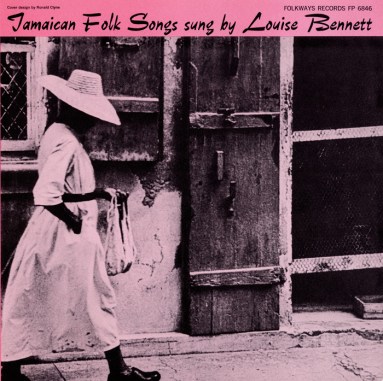 Louise Bennett-Coverley (1919-2006) also recorded “Linstead Market” for the 1954 Folkways Records release Jamaican Folk Songs. Bennett, lifelong champion of Jamaican folklore, was the person who introduced Belafonte to “The Banana Boat Song,” though it had been “Hill and Gully Rider” as she knew it. And she recorded “Linstead Market” on at least one other occasion, that time with the Caribbean Serenaders featuring Leslie Hutchinson on trumpet (Melodisc 1139) in what the 78 label describes as a “Jamaican Rhumba.” Steel band, calypso, folksong, mento, rhumba, Jamaica, Trinidad, the U. S.—the fluidity of genre, the quick movement of repertory between islands and across oceans, the surge of popular and ethnomusicological interest—all points to kind of vibrancy, a being on the leading edge of a musical revolution, a postcolonial achievement of voice. The Sound of the Sun is a brightly shining page from that story in motion.
(Nexus exit.)
 But the record I pulled off the shelf this week was not The Planets, but Holst’s Sāvitri (1908), a stunning one-act opera clocking in at about 30 minutes, with a B-side that I’d never heard: The Dream-City, a ten-song cycle that composer-conductor
  Another week, another ‘80s movie reference. Behold, I bring you: Beetlejuice (1988). Granted, the weird nightmare landscapes that Michael Keaton’s poltergeist-purveying title character slinks through in Tim Burton’s film are a far cry from the wisps of dreams in Humbert Wolfe’s poems. But something does tie together that bizarre film, Wolfe’s poetry, Holst’s settings, and Matthews’s orchestration: the strangeness of our fantasies about death.
 This science-fiction-like vision of death—which reminds me of the terrifying frozen world of the White Witch’s home planet in C. S. Lewis’s The Magician’s Nephew (1955)—becomes a marvel in Matthews’s rendering. He has forged a sonic Betelgeuse in the environment of his orchestration, with sly references to Mahler’s
  Death sings the opening section alone, without orchestral accompaniment, which might initially suggest Wagner’s strategy at the beginning of Act I of Tristan und Isolde, but in Holst there’s no prelude to set up the emptiness of the opening song. And then, magic! Sāvitri joins Death in an unaccompanied duet and reveals that his song has been running through her mind. So the first character we hear is actually the thought of another character. The stark tension between the two vocal parts seems to prophecy Peter and Ellen’s bitonal duet in Britten’s Peter Grimes, which is similarly unmoored from orchestral accompaniment. Composer-scholar Raymond Head claims that Sāvitri features Holst’s first use of bitonality (“Holst and India (III)” Tempo 166 [September 1988]: 37), and given that Britten acknowledged his debt to Holst’s harmonic thinking, the Sāvitri-Grimes link seems intriguing.
 Sound Trove