H. I:3 – An Irony at the Origins of Symphonic Counterpoint

Where does it come from, counterpoint? I don’t mean historically – I have a fair sense of that, having studied such things for some time. What I really mean is, where does the compulsion to create learned counterpoint come from in the mind of the composer? It doesn’t have to come from one place, does it?

The calculated use of counterpoint, in a dramatic context, to connote struggle, disruption, strife, is worlds away from the use of counterpoint in a genre where counterpoint is simply the expectation. I can put names to it, if that helps: for the dramatic, the use of fugato in the development section of Beethoven’s Third Symphony – an easy example, but familiar; for the expected, a Kyrie in a Mass setting by Palestrina. Unsafe versus safe counterpoint, we might say; order threatening to split apart versus the great multifarious multiplicity of things made into a harmonious whole. In other words, diametrically opposed readings prompted by the same phenomenon.

I suppose the dramatic use of learned counterpoint, to signify contention, must have been a gift from Bach and Handel. I’m thinking of the cantatas and oratorios, respectively; the Passions, as well. The claim couldn’t really be made for Schütz, could it? Stick a pin in it – something to explore on another day. That is, I can’t rule out with absolute certainty the possibility that Schütz, that magnificent musical rhetorician, used a choral fugue, say, to convey some conflict in the text. I welcome clarification from some benevolent Schützian who happens this way.

Eventually, Haydn will give us some of this – counterpoint signaling contention –  but in his Third Symphony, counterpoint is something else. Play, perhaps. Maybe that’s a Haydn ca. 1759/60 way of “turning the multiplicity of things into a harmonious whole,” but it feels more like a bit of youthful exuberance, tinged by the flexing of mental muscle. For who in 1759 would have written a symphony so committed to contrapuntal technique? Was there one other person who would have, who could have, besides our young Haydn?

I’ll make three points: two as quickly as possible and one at a bit more length.

First, the two quick things. Movements one and four are bound, yes bound, together by their first themes, each clearly designed for contrapuntal treatment by virtue of their first four notes, with each note filling up a measure to establish harmonic clarity and open up space for the activity of a countermelody. (It’s easier to see it than to read about it, so here you go.)

Fig. 1. The opening of Haydn’s Third Symphony, first movement. That’s a theme for counterpoint!
Fig. 2. And the opening of the fourth movement of Haydn’s Third. Another theme for counterpoint.

What is this, Papa Haydn? Cyclicity? Can we really accuse you of creating a “themed” symphony in 1759, with learned counterpoint itself as the “subject,” ha-ha? Would you have thought of it, and, if so, would anyone have heard you? Well of course he would have thought of it, because eventually he does think of it, and how can anyone claim that the grand arrival of the cyclic symphony in Beethoven’s Fifth is sui generis when Haydn and Mozart are teasing at the concept decades before. Still…1759, Haydn? What historical precocity! Once more, we lesser mortals bow and scrape.

I know I promised to be brief with the first two points, but I can’t resist noting the connection between what Haydn does in his fourth movement and what Mozart would do in the Finale of the Jupiter Symphony (1788), that juggernaut of symphonic contrapuntality, so grand a conception to those who heard it that it took on the name of a god. To get right to it, Mozart’s Finale also opens with a four-note, note-to-the-measure theme, primed to fulfill a contrapuntal destiny. Beyond this, there’s no comparison between Haydn’s Third and Mozart’s K. 551. One is an early work in a genre that had yet to attain much significance; the other is a summative work, harbinger of Beethoven, the last of the numbered Mozart symphonies in a genre that was quickly becoming, to the late Enlightenment, what the Mass had been for Palestrina: a place to put your best work. That Haydn was going to help usher the genre on to its exalted plane is the stuff of every music history class, but in that well-worn narrative, it’s easy to forget about early intimations like H. I:3.

Now the third point, and this one takes the cake.

If you’re familiar with Haydn’s First and Second Symphonies, you’ll know that the Third is the earliest, in the numbering system we now use, that has four movements instead of the Italian three. It gains a minuet (or “menuet,” as Haydn spelled it) in the third position. All the formal things that we know about the minuet – that it’s a paired dance with a trio, that each of the dances (minuet and trio) will be its own rounded binary form, that the convention is to play the reprise of the minuet without the repeats – are as true here, in 1759/60, as they will be when Haydn pens his last symphony. And here, in the first minuet we stumble upon while tripping through Papa H.’s symphonic oeuvre, we encounter another eternal verity, this one belonging to Haydn alone. It’s a principle, I suppose, and easily expressed: No boring dances, please. Is it important to say it? Yes, it is, so I might as well get it out of the way. Haydn’s minuets are better than Mozart’s. There. Band-aid ripped off. Let’s not dwell on it more for the moment, though perhaps in another entry I’ll have the wherewithal to step up to the plate. But for now…

Check it.

The opening of this diminutive dance, this “throwaway” minuet, is a canon. (Danced any canons lately?) And this means, of course, that three of the movements of this four-movement symphony are colored by learned counterpoint.
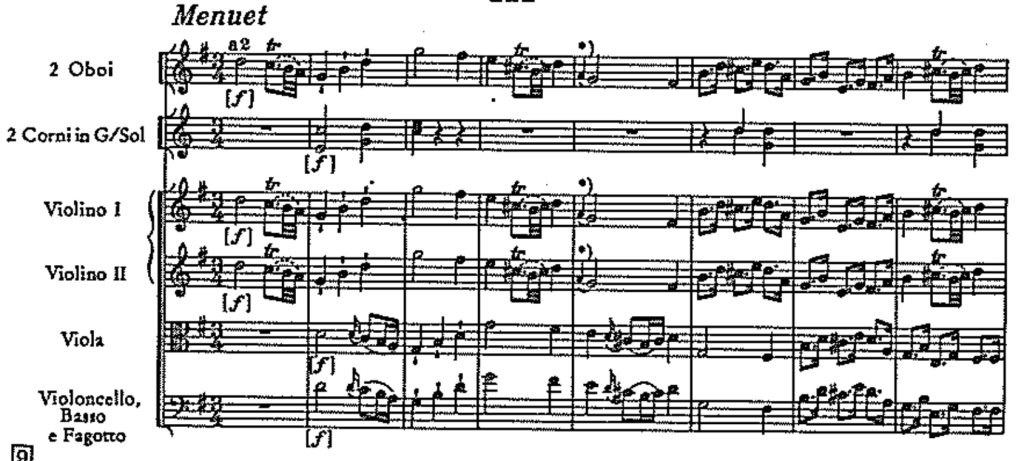
Fig. 3. Opening of the third movement of Haydn’s Third. A canon!

It gets even better. The canon in the first section (A) proceeds as one might expect, with the high voices (violins, oboes) serving as leader and the low voices (violas, cellos, basses, bassoons) answering after a measure, and this relationship continues in the second section (B). But when the reprise of the A section (A’) begins, the relationship has been reversed: now the lower voices start the canon, with the upper voices answering after a measure.

Fig. 4. The A’ of the minuet in Haydn’s Third, starting at m. 20, with the canon starting in the lower voices.

In other words, and to risk a bit of contrapuntalese, Haydn has made an invertible canon: the answer fits, harmonically, above or below the leader, a bit of contrapuntal magic that one might look for in an Art of Fugue but that comes as a complete – and delightful, even funny – surprise in a modest little dance. In the tension between genre, thematic material, and working of that material, Haydn introduces himself as an ironist.

There in his garret apartment, not long after his ignoble departure from St. Stephen’s, wretchedly poor, poring over a copy of Fux’s Gradus ad Parnassum, perhaps it occurred to Haydn: from even the most modest of origins, wonders and marvels might emerge. [1]
[1] As Geiringer writes about Haydn’s first room of his own: “It was a garret, partitioned off from a larger room in the old Michaelerhaus near Vienna’s ancient Romanesque Church of St Michael.” While there, “He devoured Joseph Fux’s famous Gradus ad Parnassum, Johann Mattheson’s Der vollkommene Kapellmeister, and David Kellner’s Unterricht im Generalbass. The copies he used have been preserved, and their numerous annotations reveal the passion with which young Haydn threw himself into the study of these subjects.” Karl Geirigner, Haydn: A Creative Life in Music, rev. (Los Angeles: Univ. of California Press, 1968), 31.

H. I:2 – What’s in a Key? C Major, Double Agent

Pardon the title. I’ve been reading too much John Le Carré, possibly.

Most recently it was The Looking Glass War, but not too long before, it was that most quintessential of double agent novels, Tinker, Tailor, Soldier, Spy, with its atmosphere of morose dejection and disaffection, of betrayal at every turn by so many sacred cows. [1]

Mutatis mutandis

Et tu, C major?

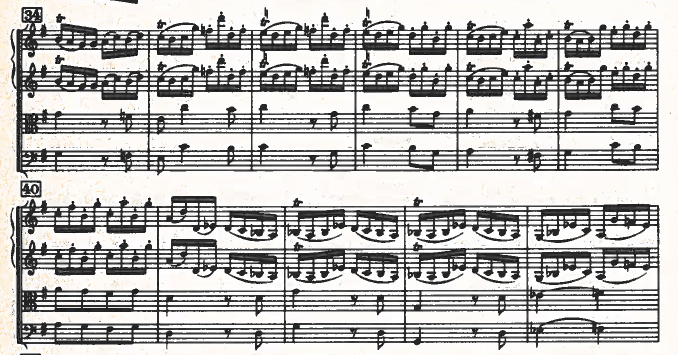
Here we are in Haydn’s Second Symphony in “C Major” (wink), and, in the opening Allegro, the second theme group is in the dominant minor instead of the expected dominant major. [2] But the galant Andante will be better behaved, surely? Not so. The second period similarly falls into the dominant minor, and with this particular theme – a perpetuum mobile with a tic of a trill – that really does seem a surprise. After what sounds to me an almost asphyxiated return to the major, we plunge into the depths for another dose of minor.

Fig. 1. Haydn’s Symphony No. 2 in C Major, II. Andante, mm. 34–44. The perpetuum mobile plunges into the depths!

You’ll just have to hear it to understand how strange it is for such a theme, in such a brief movement, to lead us time and again into the dark corners of this Arcadia. But then comes the joyous Presto – Haydn really could write a catchy tune, you know? – which couldn’t possibly have room for the minor, could it? Wrong again! After the opening rondo theme, we move to minor and stay there the length of the episode, returning to major for the rondo theme.

Are you following?

In each of the three movements (Italian design again) of Haydn’s Second, there is a significant role for the minor mode, not just as an interesting place to visit in a developmental passage, but as a structural component, a curtained room in C major’s sunlit estate.

Let’s articulate, then, what C major is meant to be. 1) The God key, as in that unforgettable arrival of Light at the dawn of Haydn’s Creation (1797–8). 2) Or the King key. 2+) Or the Queen key, like in Haydn’s second Te Deum (c. 1800), written for Empress Maria Theresa and opening in a blaze of C major. (Yes, fine, there’s a passage in the parallel minor, appropriately pitiful and pious, for the bit about helping us, “thy servants, who thou hast redeemed with thy precious blood,” but that couldn’t very well stay in major, could it?)

How do we hear large minor-mode sections in works governed by the key meant for gods and kings? Possibly the minor mode ennobles – an older way of hearing it, I’d say, and an idea we’re bound to come back to. Or possibly it undermines, throwing shade on the royal sheen. The first possibility is safer, analytically, and of course not everything rides on mode; so many other factors give a minor-mode section its particular character. On the other hand…

There’s something like a tradition of overthrowing King C major. Consider Mozart’s “Dissonance” Quartet, K. 465 (1785), coyly “in C” with that introduction of chromatic excess yielding to an exposition of bunnies-and-butterflies frolic. (OK, they’re very lyrical and charming bunnies and butterflies.) He had a chance, did Mozart, to take a page from Haydn in his second group, but, no, relatively unsullied G major is just fine for his secondary key, thanks. The development’s a slightly different story, but it’s really not until the second movement, which is mostly wistfully beautiful, that Mozart gives us a phrase of properly mournful minor.

Can undercutting C major in the eighteenth century be revolutionary behavior, or, in keeping with the overstory of this blog series, can it be an act of resistance? “God save the King” in “scare quotes”? We are, after all, talking about the century of the American and French revolutions. Just how disruptive do we allow Haydn’s modal usurpations to sound in our ears? Is it playful and harmless ribbing, or the coded rebellion of the Shostakovich of legend? Haydn has never seemed closer to the Sex Pistols. Someone make a meme.

And speaking of secret rebellion… that second movement really is weird. Two-voiced, and, as I mentioned above, a perpetuum mobile for the violins, who inflect their galant line with the occasional trill on the first sixteenth of the measure. I also alluded to the relative extremities of range in this movement. Despite its brevity – about three minutes in most recordings – and the consistency of its materials, the violin part spans two and a half octaves, with passages “seated” in each of three octaves. The effect is just a bit disconcerting and possibly becomes more so the more you listen to it. For Landon, the movement held “a hideous fascination, like the painted grin of a Harlequin in one of those open-air Punch & Judy shows that used to be a feature of the Roman parks in summer.” [3] What a thing to write, H. C.! Little wonder, perhaps, that this comment doesn’t appear in the liner notes (also written by Landon) for the The Complete Symphonies set with Dorati and the Philharmonia Hungarica, even though much of the rest of the commentary on the Second Symphony matches that in the first volume of Landon’s Haydn: Chronicle and Works. [4] I’m sure that difference mostly has to do with form: liner notes have to be more concise than summative tomes. Nevertheless, I can’t help but see in Landon’s rogue comment the very kind of thing that he hears in Haydn’s second movement. It’s a flash of grotesquerie: a jab at convention and a flash of personality, a reminder that in Haydn’s world, as in our own, it’s often an admirable quality to struggle at our bonds.

[1] “I don’t think so, Blackadder – not in the Bible. I can remember a fatted calf, but as I recall that was quite a sensible animal.”

[2] Landon writes, “The second subject of the Allegro is, as usual, in the dominant minor,” but can a “usual” practice really be claimed in a symphony written this early, when its numerical (not necessarily chronological) predecessor (No. 1) moves to the dominant major in the equivalent spot? To look for “usual” practice, it makes more sense to look, say, at early C major quartets: the first movement of Op. 1, No. 6, for example, which, for its secondary key, moves to?….G major, of course! At most, one might speak of moving to the dominant minor for the secondary key as an example of Haydn beginning to explore what will become his tendencies. H. C. Robbins Landon, Haydn: The Early Years, 1732–1765 (Bloomington: Indiana Univ. Press, 1980): 287.

[3] Ibid, 287.

[4] The Complete Symphonies of Haydn: Volume Eight, Haydn Symphonies Nos. 1–19, Antal Dorati, dir., Philharmonia Hungarica, notes by H. C. Robbins Landon (New York: Decca Record Co. STS 15310-15, 1973): 14. Note that the “first American edition” of Haydn: The Early Years followed the Dorati set by five years; it’s possible that the comment about Punch & Judy and summertime in Rome emerged in those intervening years, something that only occurred to him the longer he lived with it. I imagine Landon, in his mid-fifties, thinking carefully about what Haydn in his mid-twenties was doing writing something thus tinged with the bizarre.