
“This was like a first shot of heroin to me. I became hooked thoroughly on Ives.” So said John McClure (1929-2014), famed producer of some of the great Stravinsky and Bernstein albums for Columbia Records, about his experience of hearing the Piano Sonata No. 2 “Concord, Mass., 1840-1860,” each of the movements of which connects to the American transcendentalists: I. “Emerson”; II. “Hawthorne”; III. “The Alcotts”; IV. “Thoreau.” I had a similar reaction to Ives, though I can’t remember if the first piece of his I heard was Three Places in New England, The Unanswered Question, or the Second Piano Sonata, because once I had encountered the first, I sought out the others in quick succession. I do remember, though, that the first time I heard Ives’s Concord Sonata, my experience was, bizarrely, not that Ives’s was quoting someone else, but that someone else was quoting Ives. At the risk of being self-indulgent, I’ll take the trouble to explain.
It happened that, in the late 1980s, when I regularly fired up the Walkman to ease the passage of homework that didn’t particularly compel me (Shame!), I would often pop in a cassette of Bruce Hornsby and the Range’s 1986 album The Way It Is.  The second track, “Every Little Kiss,” opens with Hornsby’s piano solo—hardly a surprise, as that was sort of how he carved out his unconventional place in the popiverse of the Reagan years. Through repeated background listening I memorized “every little” nuance of that opening solo.
¡¡EnTeR tHe UnIvErSiTy YeArS!!. . .when I encountered Ives, as described above, and was stunned to discover that Hornsby’s opening solo was lifted straight from the opening of “The Alcotts.” Hornsby has never made any secret of liking Ives, so I think this gesture is a straightforward homage to an important musical influence and not an attempt to communicate anything connected with the household that gave the world Louisa May Alcott. Nevertheless, so fascinated was I by this connection, and by the phenomenon of initially encountering Ives’s music as something someone else had quoted instead of as a compendium of quotes itself—and the opening of “The Alcotts” is itself a compendium of quotes, as I would later learn from J. Peter Burkholder’s All Made of Tunes (Yale Univ. Press, 1995)—that I quoted the opening of “Every Little Kiss”/“The Alcotts” in a piece I wrote at university, “Job Work,” a setting of a poem by James Whitcomb Riley for tenor and chamber winds. (Here’s the really self-indulgent part—sorry.) I used the quote for Riley’s lines “And shout in glee such a symphony/That the whole world understands.” The opening of “The Alcotts” is a sly re-harmonization of the opening of Beethoven’s Fifth, so by using the Ives-via-Hornsby quote for this line, I think I must have been saying something about how the quotation and re-quotation of Beethoven points to a “symphony that the whole world understands.” But the more interesting point to me now is that my recognition of the phenomenon of quotation sparked further quotation, a compositional quirk I’ve never really been able to shake.

It was illuminating, therefore, to sit next to a (ahem) certain Ives scholar at the last American Musicological Society meeting in Rochester, and to briefly discuss, while we were waiting for Susan McClary’s talk to get underway, quotation in Ives. I said something about how different an experience Ives must be for students now, many of whom don’t know any of the tunes that Ives quotes. (Lots of people have said this; I was just being banal.) The Ives scholar pleasantly but firmly made the point that identifying a particular tune was not necessary for an enjoyment of Ives’s music—that, in fact, perceiving the quotation of style was sufficient, an argument he had been making for a very long time and one that he continued to promote through publication and, I’m happy to say, in casual conversation.
I’ve thought about that conservation frequently in the intervening months, wondering if my knowledge of, say, classical repertory and hymn tunes, makes Ives fascinating to me because of my familiarity with specific pieces or because of the concomitant familiarity with certain styles. The answer isn’t an either/or. Yes, it does mean something to identify specific quotes in Ives; it enriches the listening experience significantly. But suddenly I catch myself and wonder if what it enriches is the process of reflecting on the listening experience, and if, during the experience of listening itself, style “leads” and specificity of quotation is less significant. To identify a specific quotation is to stand outside the experience of listening, to a certain extent. (If all you’re thinking about during “Ice Ice Baby” is “Under Pressure,” you’re not in the musical moment, right?) The frequency of quotation in Ives’s music, taken with listeners’ varying abilities to identify specific pieces, would seem to suggest that the experience of listening to his music is a dance between in and out, between riding along on a current of style and considering a concatenation of distinct phenomena from a distance. This inside/outside dance that potentially characterizes listening to Ives can be initially disorienting, confusing, but it can also be terrifically exciting, because you’re not sure what the composer is asking of you. Are you in or are you out, and where should you be? There’s something about it that feels like our experience of music as an entire field; Ives seems to me always to be asking his listeners to tie the experience of a specific work to a larger conception of the messy way in which music permeates our lives. He’s after a kind of honesty that breaks down the wall between concert experiences, private musical moments, and walking around in public environments. It’s the American experimental road that leads to John Cage: a proposal for perpetual conceptual revolution that accepts all experience as fundamentally musical.
Nexus entry.
How delighted I was to encounter on YouTube a documentary and full performance of the 1965 première of Ives’s Fourth Symphony by the American Symphony Orchestra under the baton (principally) of Leopold Stokowski. The film was shot for National Education Television, which would later morph into PBS, and includes interviews with John McClure (from which the gem that opened this entry), charmingly dotty podium remarks by Stokowski, and some artful shots of the orchestra tackling what was clearly a dauntingly complicated work for them.

But the recording I listened to for this entry was the 1974 recording of the Fourth Symphony with the London Philharmonic Orchestra under José Serebrier, who was one of the assistant conductors for the televised première under Stokowski.  The atmosphere of quotation begetting quotation that Ives inspires seems echoed, therefore, in the link between the NET film and the LPO recording. This quality is brought out in Serebrier’s extensive program notes, which often reference the 1965 première. In the spirit of Ives, I can’t resist a quotation: “I shall never forget that winter morning at Carnegie Hall, when Stokowski had scheduled the first rehearsal of the Ives Fourth. He stared at the music for a long time, then at the orchestra. I had never seen the score, and my heart stopped when he turned to me and said, ‘Maestro, please come and conduct this last movement. I want to hear it.’ After it was all over, my arms and legs still shaking, I complained that I was sightreading. Stokowski’s reply was, ‘So was the orchestra!’” If they were sightreading on that first day, one of the remarkable things about the première was it was especially well prepared: Stokowski asked for (and got) a number of extra rehearsals, underwritten by the Rockefeller Foundation. (See the NET documentary at 7:55 for Stokowski’s explanation, delightfully redolent of the absent-minded professor.) But Serebrier’s recording brought with it almost an additional decade of opportunity to live with the work’s challenges and possibilities, and so it inevitably sounds more refined.
 Still, it is a revelation to listen to Serebrier’s recording while following along with the 2011 Charles Ives Society Critical Edition of the score, with each movement edited by a different scholar from the variety of sometimes conflicting sources. (This extraordinary publication includes a CD-ROM with scans of all of Ives’s manuscript material for the work.) Looking at Wayne D. Shirley’s edition of the fourth movement, for example, shows how much either was excised from or never incorporated into the edition prepared by the staff of the Fleischer Music Collection, used for the 1965 première and the 1974 recording; following the course of almost any single part reveals that much more is possible than got realized under Stokowski or Serebrier. And, well, who can blame them? Ives asks for an entirely different ensemble for each of his four movements, pushing past Richard Strauss into a kind of proto-Gruppen orchestral environment, particularly in the finale. All this in a work of the 1910s and ‘20s. Not that Ives would have recognized the finale in the 2011 Critical Edition as his, per se. As William Brooks brilliantly proposes in the preface to the edition, in the face of the impossibility of creating a single definitive edition of the finale from a multiplicity of sources, “The workable anarchy of Ives’s music is better manifested in his manuscripts than in publications; and it is the manuscripts which you [Who, me?!?!]—through whom Ives’s music sounds—can and should enter. There can be no Ives urtext, no approved edition. In the re-formed world universal access to the manuscripts will bring into being an ever-expanding sphere of visions, performances—‘editions,’ if you will—all shaped for particular times, places, circumstances. I look forward to your contributions.” This quote resonated powerfully with me as I sat there in the stunned aftermath of the last movement, thinking about the beauty of what I heard and the promise of what I didn’t hear but could almost imagine. (More of it is present in other more recent recordings, incidentally.) Could there ever be enough instruments, enough parts to satisfy Ives’s all-encompassing vision? Could there ever be enough refracted and refracting quotations to answer the call? Brooks says no, but he looks forward to a Borges-like infinite gallery of responses. How wonderful to imagine that in writing about it we come to constitute a version of the work.
Nexus exit.
I think that the idea of being unfinished, as with my entry on Mahler’s Tenth Symphony, needed to inhabit the center of this one, and that other conceptions I initially had for it—that I should mention links between Three Places in New England and the first, second, and fourth movements of the Fourth Symphony, or that I should write about “place” and the slow third movement, which has to me more than a touch of the Adagietto of Mahler’s Fifth–simply must wait. There’s great and perhaps infinite promise, after all, in what’s left unfinished.
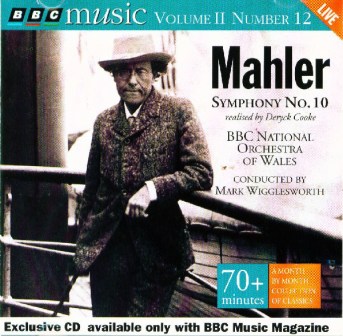 The recording I was listening to, incidentally, was of the BBC National Orchestra of Wales under Mark Wigglesworth, which accompanied the August 1994 issue of BBC Music. In some ways it makes a great deal of sense to listen to this live performance, as the 1964 concert that brought the fully realized Tenth to the world was part of that season’s Proms.
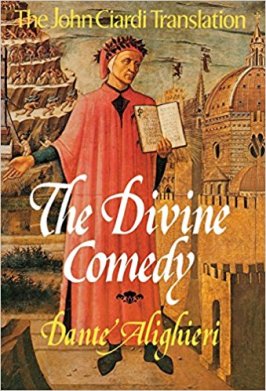 He’s the one, after all, who called his middle movement “Purgatorio,” suggesting the epic scope of Dante’s Divine Comedy and practically begging a listener to look for an Inferno and a Paradisio. Or is it really the middle three movements that function collectively as a kinetic purgatory—a waiting place, an interruption—foil to the first movement’s hell and last movement’s paradise? Music musics, ultimately, and any narrative parallel fails to fully accommodate those qualities that make the music so extraordinary.
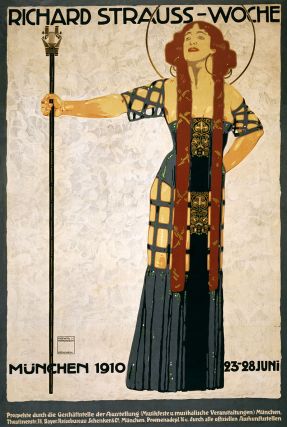 But this one bears a striking resemblance, I think, to the motive from Richard Strauss’s Salome (1905) that Lawrence Gilman called the ¡¡¡EnTiCeMeNt!!! motive in his 1907 guide to the opera. In isolation, the connection would perhaps merit little attention, but taken with the bass drum hits that open Mahler’s finale and the return of the “poisoned” chord, both of which have parallels in Strauss’s score, I cannot resist the comparison. (It’s the bass drums, remember, that crush Salome with their shields [or something like that], and who can forget the “poisoned” chord when Salome kisses the forbidden fruit, the severed head of Jochanaan?) When Mahler was sketching his Tenth the music of Strauss’s operatic success de scandale was all the rage, and Mahler certainly knew the score well. What’s Mahler doing here? Perhaps he’s contemplating, through music, another recent development in music, in just the same way that the internal scherzos reflect a kind of Schoenbergian shearing of aspects of signification from musical gesture. If Mahler is thinking about Strauss in the finale of his Tenth, the music is too potent, too evocative and immediate not to spark narrative dimensions. What forbidden fruit has Mahler’s symphonic protagonist tasted to be crushed in this way? Whatever it was, Mahler himself didn’t live to taste it. In listening to the last movement, we hear Mahler from beyond the grave, expressing things he did not have the time to express.
 Or do I go in another direction entirely and talk about the uses of Wagner—for example, the use of the Prelude from Das Rheingold in Terrence Malick’s film The New World (2005), ostensibly about the founding of Jamestown and the relationship of John Smith and Pocahontas, but projected, through the use of Wagner’s Prelude, into a larger creation myth, an originating legend for America paralleling the creation of Wagner’s world of the Ring, and/or a suggestion of the unspoiled world before European colonization.
 I take consolation from reading Deryck Cooke’s I Saw the World End: A Study of Wagner’s Ring (Oxford University Press, 1979). An attempt to say as much as could be said, Cooke managed to say intriguing things about the libretti (and occasionally the music) for the first two Ring operas, and then laid him down to rest. Somehow this is touchingly fitting, in a way that echoes other extraordinary projects of scholarship cut short by the unsympathetic winnower: Henry-Louis de La Grange’s revision of his definitive Mahler biography, J. A. B. van Buitenen’s translation of the Mahabharata. What I mean is that the epic subject is honored, in a sense, by not being fully encompassed by similarly epic scholarship. On a more pedestrian level, I was by turns upset, amused, and relieved that in the extensive liner notes + libretto accompanying Karajan’s classic recording of Das Rheingold with the Berlin Philharmonic, the essayist Wolfram Schwinger hardly mentions that singing is going on. (Yes, really!) Schwinger’s focus is almost exclusively on the Master—Karajan!—and his sensitivity to orchestration, his commitment to accuracy, transparency, his refusal to get bogged down and insistence on maintaining forward momentum. All well and good, but. . .singers?
 After all, here is Dietrich Fischer-Dieskau as Wotan, the ultimate singer of German Lieder crafting a father of the gods who is lyrical and sympathetic instead of brash, spoiled, tyrannical. And here is the masterful performance of Gerhard Stolze as Loge, who follows every opportunity for multi-dimensionality of character that Wagner provides: at one moment playfully mercurial, at another fiercely scornful, at another distant and wise. And here is Martti Talvela as Fasolt, volleying blasts of bass sonority over the orchestra and hamming it up marvelously as the unlikely love-struck giant. But perhaps this is why Schwinger doesn’t say much about the singers—they do their job splendidly, on the whole, so his focus is free to flit to other phenomena. (How’s that for Stabreim?) All this to say that, after delay and uncertainty, I feel liberated not to attempt the completist’s gambit. Flit, float, fleetly flee, fly—it will be enough to be and not to be enough.
 (Don’t say anything about Tolkien. . .don’t say it!!! No, go on and say it—you’re in the nexus!)
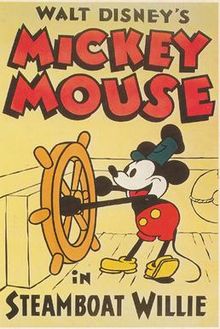 Wagner invites us to consider, though, what might have happened had one of the Rhinemaidens chimed, “Oh, so he doesn’t replace the toilet paper and puts his elbows on the table—can’t help lovin’ that dwarf of mine!” And how does he invite us to consider this possibility? By writing mock-love music, of course! The Rhinemaidens sing, each of them, as if they’ve fallen for our sulfurous cave-dweller, and he buys it each time. But we know better, and not just because of the narrative context. Wagner hams it up, giving us saccharine overtures interrupted by action-oriented “underscore.” (Incidentally, do you realize how much mickey-mousing there is in Das Rheingold?! Steamboat Willie, sit down!) The music shifts gears too quickly for us to hear the love music as genuine; something that gets that sticky that quickly must be manufactured.
 Wagner was the kind of brilliant orchestrator who understood the cultural significance of timbre, particularly as it had been used historically in opera, and knew therefore how to use timbre to communicate dramatic ideas. But the world of the Ring seems to me to have presented Wagner with the perhaps singular opportunity to associate instruments with primal elements. Okay, so this idea is partly formed at best, but I’m recording it nonetheless as one of those topics to keep in mind as the life journey that constitutes anything more than a passing familiarity with Wagner’s Ring continues to unfold. Long may it last and never reach its end.
 Sound Trove